This Giant Planet Survived the Death of its Star
All stars die eventually, including our Sun. Depending on the star, that can spell doom for planets. Massive stars die in cataclysmic explosions called supernovae, and their powerful blast waves can destroy any planets within range. If our Sun were massive enough to explode like this, it would mean an instantaneous end for Earth. But the Sun isn’t big enough.
Instead, the Sun’s end is more prosaic. As it runs out of fuel for fusion, it will gradually swell and cool, becoming a red giant. As it swells, it will engulf Mercury and Venus, but maybe not Earth. Astronomers aren’t certain, but Earth may survive the Sun’s swelling. If it does, it’ll face much different prospects. Earth will then orbit a white dwarf, for a time surrounded by a glorious nebula created by the Sun as it shed layers of gas. But that fate is uncertain, too.
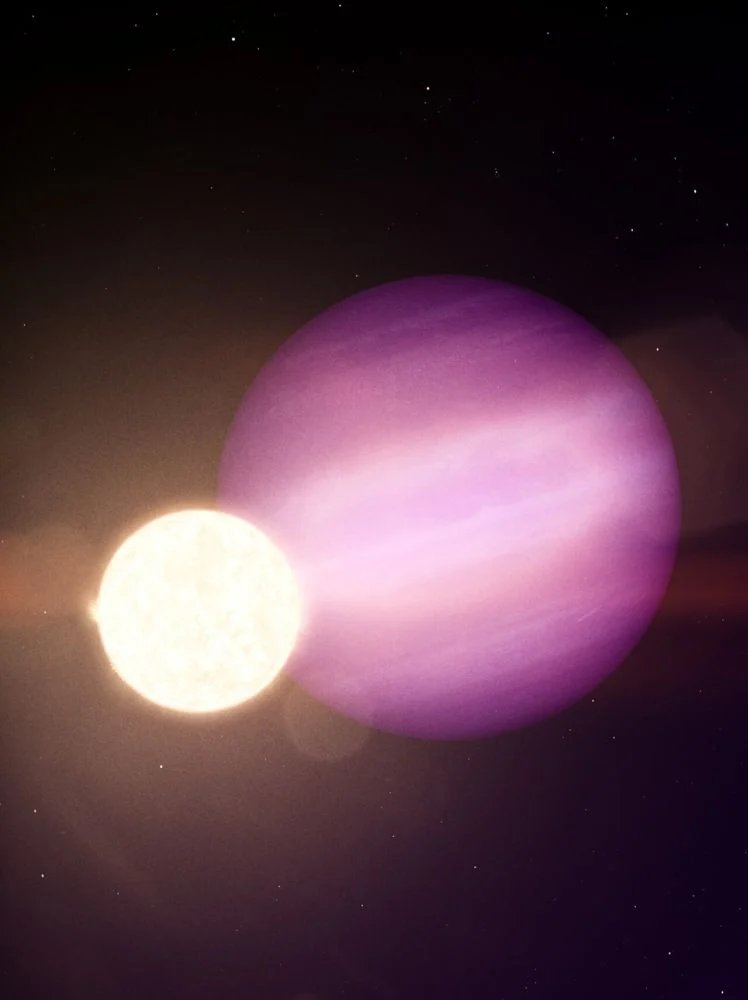
Astronomers have found intact planets orbiting white dwarfs, showing that planets can survive the evolutionary shift of their stars. One of them is named WD 1856 b, where WD stands for white dwarf. It’s about 80 light years away, and TESS discovered it in 2019. The star it orbits is about 5.8 billion years old and half the mass of the Sun.
The planet is a giant with a radius about 10 times larger than Earth’s. It’s extremely close to its star, orbiting at about 0.02 astronomical units. It whips around the star rapidly, with an orbital period 60 times shorter than Mercury’s around the Sun.
Since its discovery, astronomers have wondered about it. To be in this orbit, the planet could have migrated inward after the star became a white dwarf. Otherwise, it would’ve been destroyed by engulfment when the star became a red giant.
This planet has led to questions about habitability. If planets can survive a star’s red giant phase, can they somehow be habitable? White dwarfs don’t generate heat by fusion, but they have remnant heat that can take trillions of years to dissipate, enough to power life on a nearby planet.
Scientists want to know how the planet survived in the first place, and new research in Nature examined its atmosphere for clues. It’s titled “Aerosols and hydrocarbons in the atmosphere of a white dwarf planet.” The lead author is Ryan MacDonald, a lecturer in extrasolar planets at the University of St. Andrews in Scotland.
“The planet is quite the oddball,” said lead author MacDonald in a press release. “It’s about the size of Jupiter, but the white dwarf it orbits is the size of Earth, so the planet is seven times larger than its star.”
Since it’s the size of Jupiter, this system could be a glimpse into the future of our Solar System. When the Sun becomes a red giant, it will engulf planets that are too close. But the fate of the more massive planets further from the Sun is unclear.
“We’re used to looking back in time when we use telescopes, but this is the first time we have been able to look forward to what might happen to the outer planets around the remnant of a Sun-like star. It’s like using a time machine to peer into the distant future of our Solar System,” added MacDonald.
“Several planet candidates have recently been identified orbiting white dwarfs, demonstrating that planets can survive the stellar post-main-sequence stage intact,” the authors write. “Little is known about the atmospheric composition of post-main-sequence planets, with the most evolved transiting planets with atmospheric detections so far orbiting subgiants.”
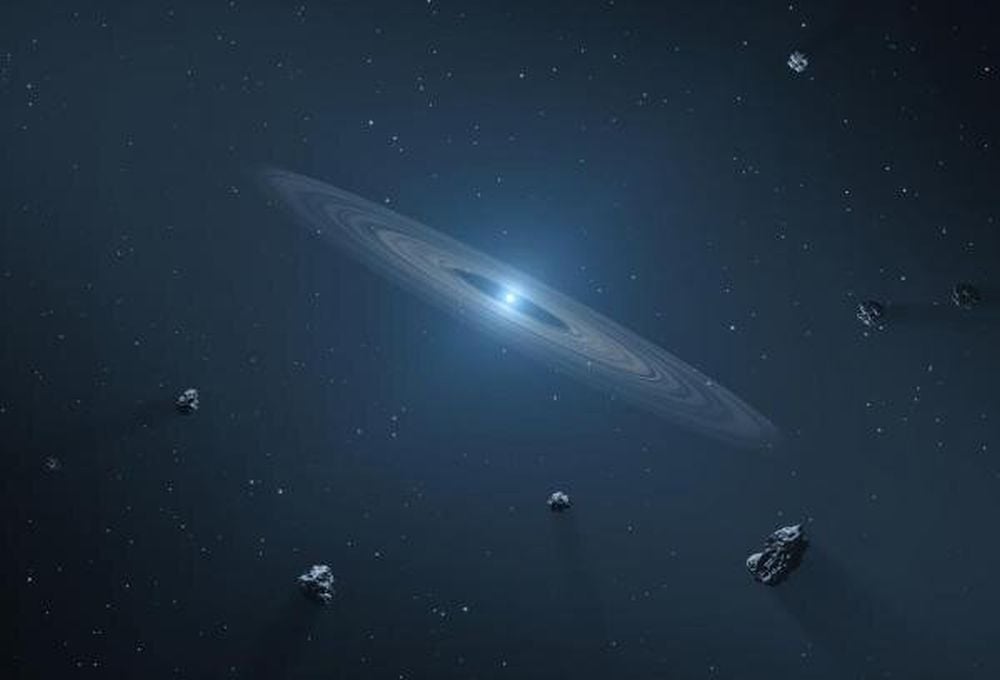
When a red giant star engulfs its closest planets, it can create a debris disk. Astronomers think it’s possible that explanets could form in this disk, but that’s not possible in this situation. The debris disks aren’t massive enough for a planet this massive to form.
That leaves only two explanations for WD 1856 b: it may have been engulfed by the star and somehow survived, coming out of the harrowing experience intact. Or it migrated inward without being engulfed. That inward migration didn’t have to be driven solely by the star itself. WD 1856 is actually a triple star system with two red dwarfs.
“The big question is how WD1856b ended up where it is today, and there are two theories,” said study co-author Christopher O’Connor of Northwestern’s Center for Interdisciplinary Exploration and Research in Astrophysics. “One is that the planet was swallowed by its host star as it was dying and managed to survive on the other side. The other is that the migration took place due to the gravitational effect of other objects in the system. The white dwarf is part of a triple star system, and the outer companion stars could have influenced WD1856b’s orbit.”
This work is based on observations of the planet’s atmosphere with the JWST. The researchers used the telescope to obtain transmission spectroscopy with the telescope’s NIRSpec instrument. They also determined the planet’s temperature. The results are vital clues to the planet’s history.
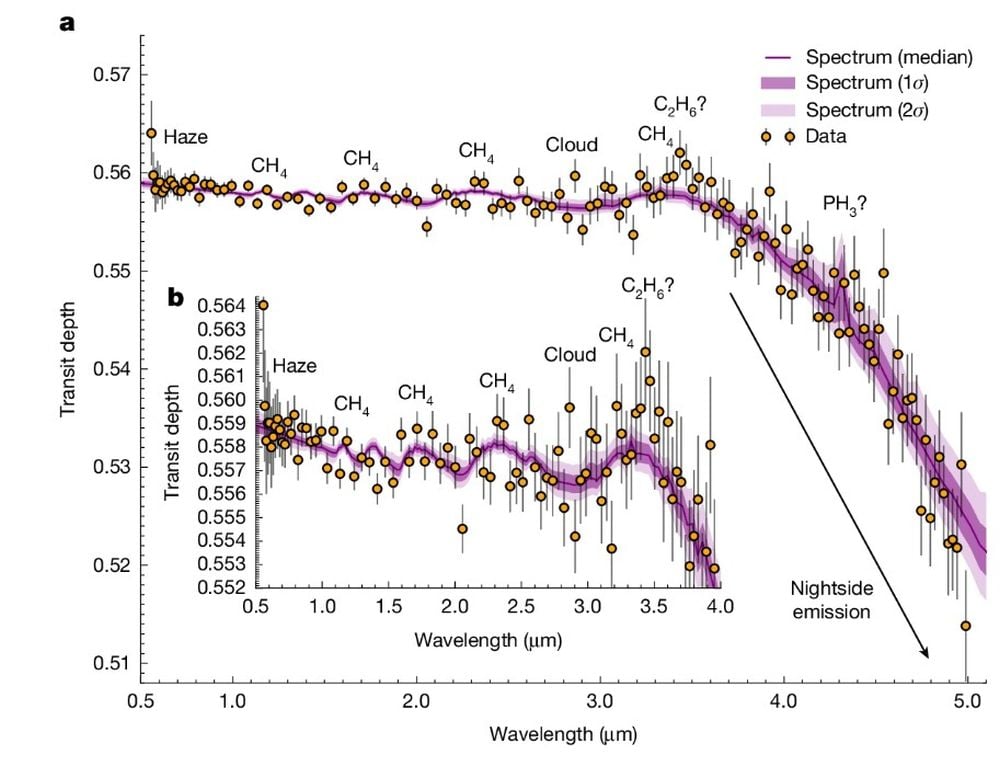 This is the atmospheric retrieval of the transmission spectrum of WD 1856 b from the JWST. It shows multiple CH4 absorption features and one tentative ethane feature. Image Credit: MacDonald et al. 2026 Nature.
The temperature is much higher than expected. While the expected planetary equilibrium temperature is about 160 Kelvin, the temperature as measured is between 390 and 412 K. So the planet is much hotter than it should be if it were heated only by starlight. These observations show that the planet survived the red giant phase, migrated inward and experienced heating. This can also explain the exoplanet’s tight orbit.
“On the basis of cooling models, these results indicate that WD 1856 b underwent a migration-related reheating event 3.0–5.5 Gyr into the white dwarf phase, consistent with post-main-sequence tidal evolution to the present-day 0.02-au circular orbit,” the authors write.
 The JWST detected an abundance of methane in the giant planet’s atmosphere. This strongly suggests that it formed further away from the star and migrated inward. Image Credit: NASA, ESA, CSA, Joseph Olmsted (STScI)
The observations found hydrocarbons in the atmosphere, specifically methane (CH4), at about 7%. This is also evidence of the planet migrating inward after the star’s red giant phase. A 7% CH4 atmosphere is a carbon-rich atmosphere. For this much methane to be present, the planet’s H2 atmosphere had to be enriched by carbon. This strongly suggests that the planet formed beyond its system’s water and carbon monoxide ice lines, then migrated inward.
“Our findings have bearing on the long-term fate of our solar system,” O’Connor said. “In roughly five billion years, our Sun will die, and we don’t know precisely what will happen to the planets at that time. The fact that planets can survive into that final stage of the stellar life cycle really widens the range of possibilities for where and when habitable planets might exist in the universe.”
There’s much to learn about exoplanets and their fates as their stars age and leave the main sequence. While the JWST is known for examining the red-shifted light from ancient objects like the first galaxies, one of its science themes is planetary systems. It’s powerful spectrometry capabilities let it examine exoplanet atmspheres in detail, providing clues to their origins, and their fates.
“Our results provide a window into the ultimate fate of giant planets orbiting stars with masses similar to our Sun,” the authors write. “As WD 1856 b demonstrates, spectroscopy of planets orbiting white dwarfs offers a new opportunity to determine the fate of planetary systems after the death of their star,” they conclude.