An Extended Barrage of Asteroid Impacts Made Earth Too Hot to Form Continents
The formation of continents was an important step in Earth’s history. Continents and plate tectonics are connected to the planet’s habitability, and the same is true for the habitability of other rocky exoplanets. Understanding when and how continents formed, and what factors and processes governed it, is one of planetary science’s major goals.
Plate tectonics are how Earth governs its climate by removing carbon from the atmosphere. Tectonics also maintains nutrient cycles, preventing critical nutrients like phosphorous from being locked into rock, unavailable to lifeforms. Though they can’t be certain, scientists think that plate tectonics are likely critical for life, and plate tectonics can only get going once stable continental crust forms.
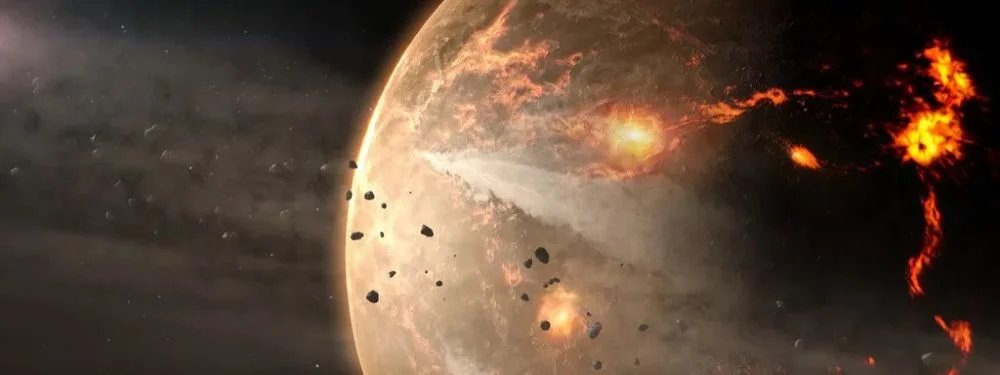
After its formation, the Earth was a magma ocean with no solid surfaces, kept molten by radiogenic heating. This time is called the Hadean eon. Eventually the planet cooled, and stable, thick continental crust formed. New research shows that thick crustal material was unable to form during the Hadean because an ongoing barrage of asteroid impacts made the crust too hot. At the same time, the heat generated more material that later formed the silica-rich crust.
The research is published in Science and is titled “Impact heating and the hidden Hadean.” The lead author is Tim Johnson, a Professor in Curtin University’s School of Earth and Planetary Sciences and its Curtin Frontier Institute for Geoscience Solutions.
“The nature of Earth’s crust during the Hadean eon [≥4.03 billion years ago (Ga)] is uncertain,” the authors write. “Models of the early Earth account for heat coming from inside the planet, in spite of evidence of intense bombardment by impactors and the heat they delivered.” In this work, the researchers modeled impactor heat flux and showed that it dwarfed the heat originating in the planetary interior. “Earth’s Hadean crust would have been extensively molten at depths below a few kilometers, causing gravitational segregation of dense, iron- and magnesium-rich material and driving average crustal compositions to become increasingly silica rich,” they write.
Differentiation is when a rocky planet’s magma separates into layers with different densities, and gravitational segregration is part of that. On Earth, iron and nickel sank to the core, where they generate Earth’s magnetic shield. Lighter elements rose, and they dominate Earth’s crust. Within the crust, the process also creates what’s called felsic rock, which is abundant in the lighter elements like silicon, oxygen, and aluminium, and mafic rock, denser rock containing more of the heavy elements magnesium and iron. Felsic rock is lighter continental crust, while mafic rock is heavier oceanic crust.
The Hadean eon began when Earth formed about 4.6 billion years ago and ended about 500 million years later. The Hadean eon ended when the hypothesized Late Heavy Bombardment began. (It’s worth noting that while the LHB is a popular concept, it’s still only a hypothesis, with many in the science community disputing it.)
The work also shows that this impact-generated heating would’ve diminished by 3.9 billion years ago, and that’s when Earth’s crust thickened. This lines up with the end of the LHB. The oldest fragments of continental crust, the Acasta Gneiss in northern Canada, dates to this time, adding solid support for these results. “That enduring continental crust appeared around this time is likely not a coincidence,” the authors write.
When we look around Earth today, we can see individual craters dating back tens of thousands, even millions of years. These are the result of individual impacts that were separated by long intervals of time. But during the LHB, asteroids rained down on Earth in a sustained episode. It was likely caused by the migration of the Solar System’s giant planets, which upsed the gravitational order that kept asteroids in line.
“There is a temptation to think of large impacts as short-lived events that scar a planet’s surface and then pass,” Professor Johnson said in a press release. “But the early Solar System was full of collisions, and the Moon preserves that history in plain sight. Those impacts carried enormous amounts of energy, and that energy had to go somewhere.”
“The extra heat from impacts would have kept much of the early crust weak and partially molten, making it difficult for rocks to survive,” Johnson said. “At the same time, those conditions would have helped produce more silica-rich crust, which later became the foundation of the continents.”
Repeated impacts carried kinetic energy that transformed into heat, generating magma that kept the early Earth’s crust from solidifying and becoming stable.
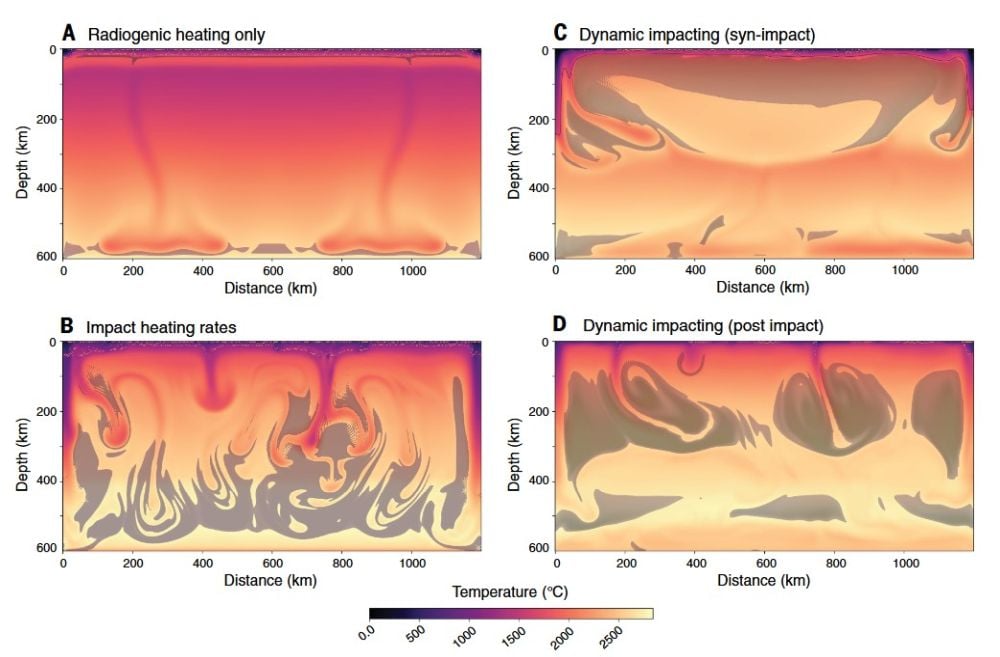
“On the early Earth, much of that energy would have been transferred into Earth’s mantle, the thick layer immediately beneath the crust, as heat,” said co-author Professor Craig O’Neill from the Queensland University of Technology. “That would have caused mantle beneath and around the impact site to rise and melt, producing large volumes of magma.
“Our results suggest the early crust was thin and unstable for much of the Hadean, not a world with strong plates behaving in a familiar modern way,” O’Neill added. “Instead, impacts would have helped keep the crust hot, weak and mobile, while driving melting and recycling on a planetary scale for tens to hundreds of millions of years after the initial collision.”
“Our results, which are based on a conservative estimate of the relevant variables, show that the heat associated with impacts in early Earth far exceeded the internal heat budget for the entirety of the Hadean eon, such that the crust would have been partially molten at depths below a few kilometers,” the researchers explain in their paper. Plate tectonics can’t happen until the crust thickens and becomes stable. The crust needs to be able to subduct as a “semi-coherent slab,” the authors write, and that couldn’t happen with all of the impact heating.
“Our findings show that such a behavior is untenable in the Hadean and earliest Archean,” they write. “Notably, our results provide a clear explanation for the almost complete absence of a Hadean rock record.”
After about 3.9 billion years ago, the rate of impacts lessened. The crust was then able to cool and solidify to a depth of about 30 km.
“That felsic rocks that dominate the ancient cores of continents began to appear at the same time seems unlikely to be a coincidence,” they conclude.