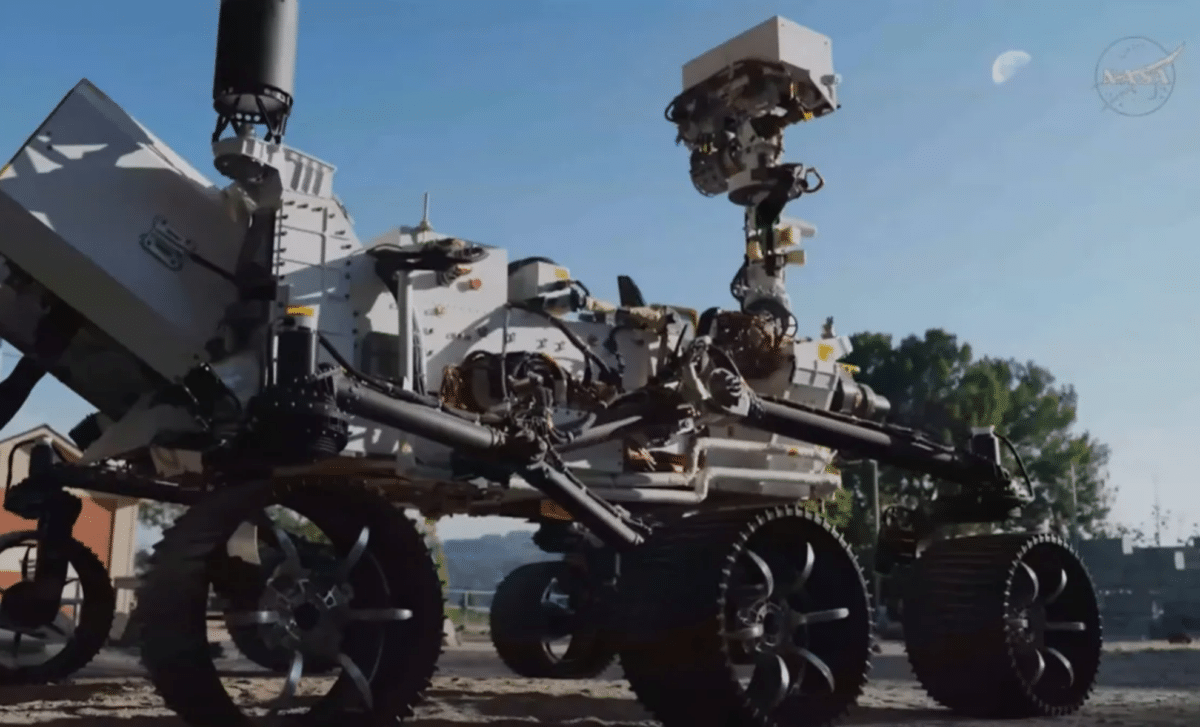
NASA Could Send A Nuclear-Powered Mars Rover Built For Earth To The Lunar Surface
NASA may be preparing to give one of its most recognizable rover designs an entirely new destination. During a recent Artemis update, the agency revealed that it is studying the possibility of sending PROMISE, a spare engineering model based on the Perseverance and Curiosity Mars rovers, to the Moon’s south pole. The concept could transform an Earth-bound test vehicle into a working lunar explorer, offering a rare opportunity to reuse proven technology while advancing future Artemis objectives. The announcement, supported by NASA’s Jet Propulsion Laboratory (JPL), highlights an approach that could accelerate lunar exploration using hardware that already exists.
Why NASA Wants To Send A Mars Rover To The Moon
The proposal centers on PROMISE, short for Polar Rover for Observation, Mapping, and In-Situ Exploration, an engineering rover originally built to test software updates, driving commands, and engineering procedures before they were transmitted to Curiosity and Perseverance on Mars. For years, the vehicle has remained safely on Earth, allowing engineers to verify complex operations without risking billion-dollar missions millions of miles away.
Now NASA believes that same rover could become much more than a test platform. Because PROMISE already shares many systems with the successful Mars rovers, engineers see an opportunity to adapt it for real scientific exploration on the lunar surface. Unlike many planned robotic lunar vehicles, PROMISE is powered by a radioisotope thermoelectric generator (RTG) rather than solar panels. That means it could continue operating through the Moon’s prolonged periods of darkness, a major advantage near the lunar south pole where lighting conditions are highly variable.
NASA Administrator Jared Isaacman explained the thinking behind the proposal, saying, “We’ve had years now of experience operating the two rovers on the surface of Mars, and we’ve got this hardware that the taxpayers have invested a lot in. So the question was posed: ‘What if we send it to the moon?’” The concept reflects NASA’s growing interest in making greater use of existing technologies instead of developing entirely new systems whenever practical.
A Proven Test Platform Could Become A Lunar Explorer
According to NASA’s Jet Propulsion Laboratory (JPL), PROMISE has spent years helping mission teams safely validate commands before sending them across millions of miles to Mars. That history gives engineers confidence that the rover is built upon hardware with an exceptional operational record.
JPL’s connection to the project extends well beyond engineering. “They weren’t going to mess anything up out here,” Jia-Rui Cook told Space.com. Cook works with JPL’s media relations. The statement reflects the careful culture surrounding rover development, where every system is thoroughly tested before being considered for flight.
The engineering philosophy behind PROMISE is rooted in experience earned through multiple generations of robotic exploration. “Landing on Mars is hard,” Cook said. The extraordinary challenge of delivering heavy robotic vehicles safely onto another world has forced NASA to refine technologies over decades of missions. Those hard-earned lessons are now shaping ideas for future lunar exploration.
Cook also emphasized NASA’s willingness to capitalize on previous achievements rather than starting from scratch. “If we’ve done it successfully already, then we’ll build on that,” she said. That mindset aligns with NASA’s broader Artemis strategy, which combines proven technologies with new commercial partnerships to establish a sustained human and robotic presence on the Moon.
The Moon’s South Pole Is Becoming NASA’s Top Priority
PROMISE would not travel to the Moon alone. NASA also announced new commercial lunar landing contracts involving Astrobotic, Firefly Aerospace, and Intuitive Machines, with each company expected to deliver scientific payloads to the lunar surface under the Commercial Lunar Payload Services (CLPS) initiative.
These robotic missions are designed to prepare the way for astronauts by studying terrain, radiation, landing conditions, and resources. Instruments aboard future landers will investigate how rocket exhaust interacts with lunar dust, improve navigation using laser retroreflectors, and measure radiation levels across different regions of the Moon.
The lunar south pole has become one of NASA’s highest priorities because scientists believe it contains significant deposits of water ice trapped inside permanently shadowed craters. Water could eventually support future astronauts by providing drinking water, breathable oxygen, and even rocket fuel. At the same time, the region presents difficult environmental challenges, including rugged terrain and rapidly changing illumination. A rover capable of operating independently of sunlight would offer a unique scientific advantage in such conditions.

Image credit: Astrobotic/Intuitive Machines/Firefly
NASA’s Culture Of Exploration Continues To Drive Bold Ideas
The PROMISE concept also reflects the distinctive culture inside JPL, where engineers regularly tackle missions once considered impossible. Innovation has long been fueled by a willingness to test unconventional ideas while maintaining rigorous scientific standards.
That openness extends beyond engineering itself. “We collect the data and we hand it over,” Craig said. “Everything we do is released to the world.” The statement captures NASA’s commitment to sharing scientific results openly with researchers and the public, allowing discoveries to benefit the global scientific community.
The passion of the teams behind these missions is equally evident in the atmosphere at JPL. “We fly our nerd flags extremely high here at JPL,” McClure said. “So high we have had four marriage proposals at the center of the universe.” The remark illustrates the enthusiasm shared by the people responsible for designing and operating some of humanity’s most ambitious robotic explorers.
Although PROMISE has not yet been formally approved for launch, the proposal demonstrates how NASA continues searching for creative ways to maximize existing investments while preparing for the next era of lunar exploration. If the mission moves forward, a rover originally built to support Mars exploration could soon leave Earth for an entirely different world, proving that even a backup machine can still make history.