What’s in the Southern Hemisphere sky this month?
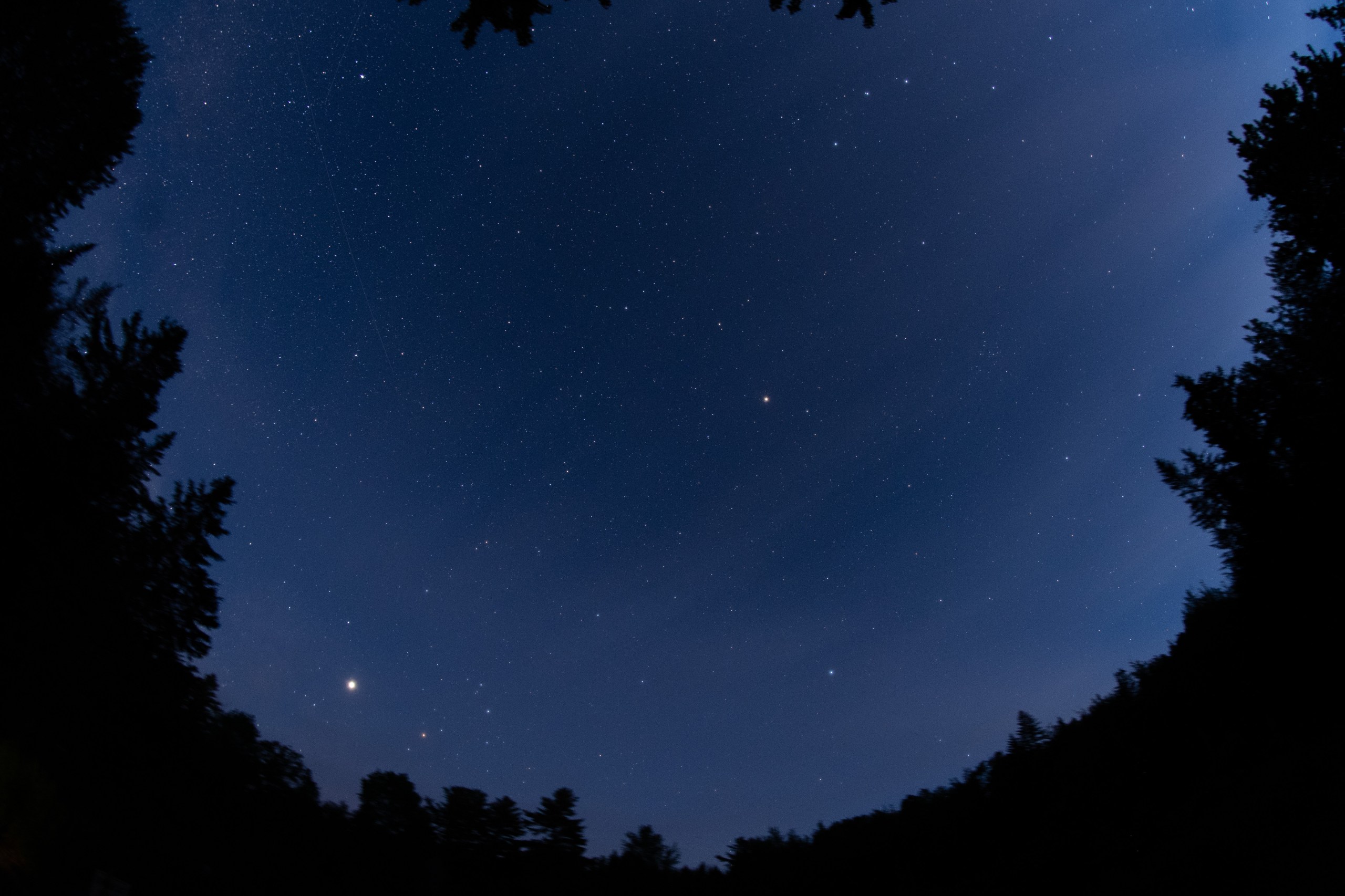
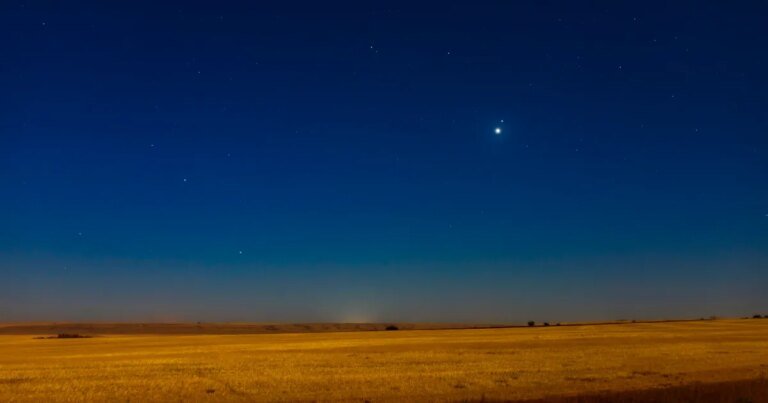
As July begins, three planets adorn the early evening sky. Look toward the northwest and you’ll see Venus. The planet shines brilliantly at magnitude –4.1 and shows up easily 30 minutes after sunset. It creeps slowly away from the Sun and into a darker sky as July progresses.
Venus also becomes more attractive through a telescope this month. On July 1, its disk measures 16″ across and is 69 percent lit. By the 31st, it spans 21″ and appears 56 percent illuminated. The planet’s gibbous phase shows up nicely in small scopes, though the view will improve noticeably in the next few months.
You’ll find Jupiter to the lower left of Venus. The giant planet shines at magnitude –1.8, bright enough to appear conspicuous against a twilight sky. Unfortunately, Jupiter succumbs to the Sun’s glare within a couple of weeks and reaches solar conjunction July 29. It will return to view before dawn in late August.
The planet’s low altitude means a telescope won’t provide the best views of the gas giant’s dynamic atmosphere. However, you should still be able to see its four bright Galilean moons.
Innermost Mercury is disappearing even more rapidly than Jupiter. Look for it 5° to the giant planet’s lower left on the evening of the 1st. Mercury glows at 2nd magnitude and will be difficult to spot with the naked eye. A telescope reveals the inner world’s beautiful crescent phase.
After passing through inferior conjunction July 13, Mercury climbs into view before dawn. You can find it some 6° high in the east-northeast about 45 minutes before sunrise. At magnitude 0.5, it should be fairly easy to spot. And a telescope once again shows the planet as a pleasing crescent.
Beautiful Saturn rises in the east just before 1 a.m. local time in early July and some two hours earlier by month’s end. The ringed world shines at magnitude 0.6 against the dim background stars of southern Pisces the Fish, just across the border from Cetus the Whale.
A telescope provides stunning views of Saturn. The sharpest images come when the planet climbs highest in the sky shortly before morning twilight starts to paint the sky. In mid-July, you’ll see Saturn’s globe measuring 18″ across the equator while the rings span 41″ and tilt 9° to our line of sight.
In addition to the lovely rings, watch for the planet’s brightest satellites. Any telescope reveals 8th-magnitude Titan, the solar system’s second-largest moon. And a 10-centimeter instrument gathers enough light to reveal the 10th-magnitude glows of Tethys, Dione, and Rhea. Also keep an eye out for Iapetus. This two-faced moon shines at 10th magnitude around its greatest western elongation in mid-July. It then lies some 9′ from Saturn.
The final naked-eye planet, Mars, rises about three hours before the Sun all month. The magnitude 1.3 Red Planet begins July against the backdrop of Taurus, beautifully placed between the Pleiades and Hyades star clusters. Mars moves steadily eastward relative to the background stars, ending the month nearly between the tips of the Bull’s horns.
Mars remains a disappointing telescopic subject, showing a featureless disk just 5″ in apparent diameter. Better views await when the planet comes closer to Earth this spring.
The starry sky
Star colors have always fascinated me, and I especially enjoy pointing out these colors when school classes visit my planetarium. Many schoolkids have yet to notice the distinctly orange-red color of Antares in Scorpius the Scorpion, which passes nearly overhead on July evenings. Because most people associate the color red with heat, I always like to mention that red stars actually have cooler surface temperatures than yellow or blue-white ones.
Experienced stargazers know that Antares appears reddish, but most casual observers don’t realize that Gacrux (Gamma [γ] Crucis), the star that marks the top of the Southern Cross in the constellation Crux, also has an orange-red color. Although it’s easy to see the color of this magnitude 1.6 star, I think the reason why fewer people realize it’s red is that the Australian flag shows all five stars in Crux as white. For a significant portion of the population, the flag is how they perceive this constellation’s star colors.
The flags of Brazil, Samoa, and Papua New Guinea also show the Southern Cross and, as on the Australian flag, they all depict the stars as white.
Intriguingly, this is not so on the flag of New Zealand. Its flag shows the Cross as having four red stars, each with a white border. So, none of the five crosses on these flags shows the stars in their true relative colors.
Still less known is that the color of the star Ginan (Epsilon [ε] Cru) also differs from the blue-white tints exhibited by most of Crux’s stars. Magnitude 3.6 Epsilon appears yellow-orange, but because it shines more dimly than Antares or Gacrux, this delicate hue doesn’t show up easily to the naked eye. Ginan has a spectral type of K and has a warmer surface temperature compared with the M stars Antares and Gacrux. Try observing Ginan with binoculars or a telescope. Their superior light-gathering power should help you perceive its color. Another way is to take an out-of-focus picture of the Southern Cross — try it, and see the curious result.
Star Dome
The map below portrays the sky as seen near 30° south latitude. Located inside the border are the cardinal directions and their intermediate points. To find stars, hold the map overhead and orient it so one of the labels matches the direction you’re facing. The stars above the map’s horizon now match what’s in the sky.
The all-sky map shows how the sky looks at:
9 p.m. July 1
8 p.m. July 15
7 p.m. July 31
Planets are shown at midmonth