NASA will send a soccer ball to the moon — if the US wins the World Cup
Jared Isaacman is doing his best to spur his country on to sporting glory.
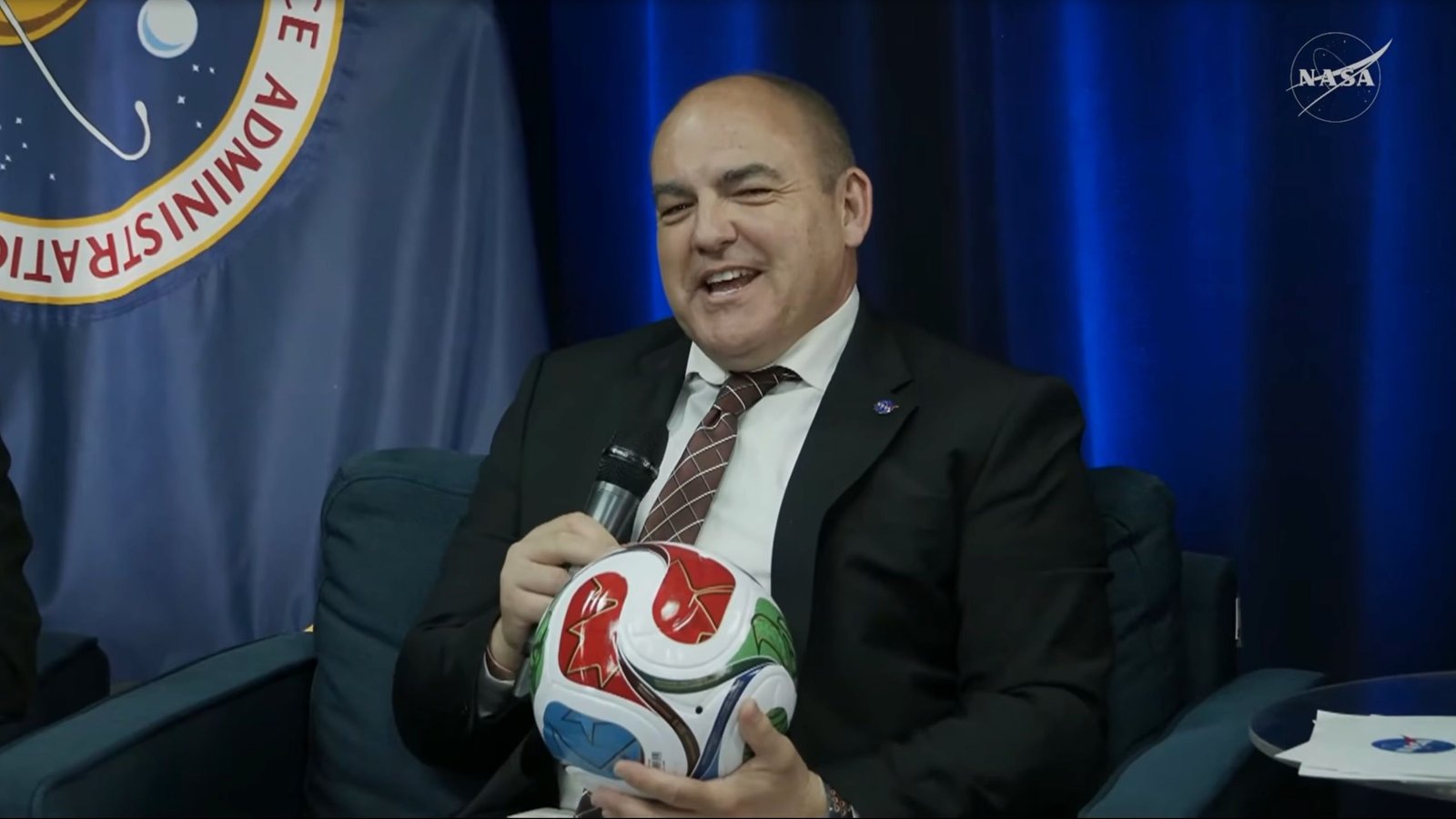
The NASA chief announced on Tuesday (June 30) that the agency will send a FIFA World Cup 2026 soccer ball to the moon if the U.S. men’s national team manages to win the tournament, which is going on right now.
“So, a little bit of motivation for the United States here on this one,” Isaacman said during a livestreamed press event on Tuesday. “We’re going to one-up Alan Shepard in the golf game on the lunar surface, and we’re going to get the soccer ball there.”
Shepard famously smuggled two golf balls and an improvised club onto the Apollo 14 mission, which he commanded. On Feb. 6, 1971, the NASA astronaut hit those balls on the moon, becoming the first person ever to play a sport on another world.
The soccer-ball plan, by contrast, would be a sanctioned affair; Isaacman and Carlos García-Galán, manager of NASA’s Moon Base program, are both behind it.
“I don’t know which lander it’ll wind up going in,” Isaacman said during Tuesday’s event, the second of the agency’s monthly updates about its plans to build a crewed outpost near the lunar south pole via its Artemis program.
Turning to García-Galán, he added, “I’ll leave that to you guys, to handle the payload.”
“We will take on that challenge,” García-Galán replied. “It will be super exciting to do that if they win. Good luck.”

The U.S. men’s team will probably need some luck to win the World Cup, an every-four-year event that’s currently being jointly hosted by the U.S., Canada and Mexico. The American men have won just two knockout-round games in the entire history of the tournament, and one of those came in 1930, during the first-ever World Cup.
The 2026 team has performed better than most of its predecessors to this point, however; the Americans won their four-team group to advance to the single-elimination stage, beating both Paraguay and Australia before losing a meaningless game to Turkiye. (The U.S. had already clinched the group win at that point.)
The U.S. plays Bosnia-Herzegovina in a Round of 32 match on Wednesday (July 1). To hoist the World Cup trophy, the Americans would have to win that game, then four more after that, likely against some perennial soccer powers.
If they make it to the quarterfinals, for example, they’ll likely face Spain, which won the World Cup in 2010 — a potential matchup flagged by García-Galán, who’s from Málaga.
The U.S. women’s soccer team has enjoyed a great deal more success at the international level, winning four of the nine FIFA Women’s World Cups to date. (The women’s tournament, which is also held every four years, was first played in 1991.)

A moon mission wouldn’t be the first trip off Earth for the official FIFA World Cup 2026 soccer ball. NASA also sent one of the balls to the International Space Station, where astronauts played with it in the Kibo module.
“We’re working to inspire the next generation by showing how space exploration inspires innovation in sports science — and everyday life,” the agency said via X on June 20, in a post that included video of the off-Earth action.