NASA Is Creating a Fifth State of Matter in Orbit to Unlock the Secrets of Quantum Physics
The International Space Station has once again become the stage for groundbreaking science, as NASA continues expanding the capabilities of its Cold Atom Lab, a unique facility designed to create one of the rarest forms of matter ever observed. With a newly installed upgrade, the orbiting laboratory is giving scientists an opportunity to study quantum phenomena under conditions that simply cannot be reproduced on Earth. The achievement marks another major step toward understanding the fundamental laws that govern the universe while laying the foundation for future quantum technologies.
The International Space Station Offers A Perfect Environment For Quantum Research
For decades, physicists have searched for better ways to observe matter behaving according to the rules of quantum mechanics. Those rules become especially visible when atoms are cooled to temperatures only fractions of a degree above absolute zero, allowing them to merge into what is known as a Bose-Einstein condensate. This extraordinary state of matter was first predicted in 1924 through the work of Albert Einstein and Indian physicist Satyendra Nath Bose, although scientists did not successfully produce one until 1995, an achievement later recognized with the Nobel Prize in Physics.
Unlike laboratories on Earth, the International Space Station provides prolonged periods of microgravity that dramatically improve the quality of these experiments. Without gravity constantly pulling on the ultracold atoms, researchers can observe their quantum wave behavior for much longer periods, producing cleaner measurements and revealing subtle physical effects that would otherwise disappear almost instantly. According to NASA, the latest upgrade to the Cold Atom Lab further enhances these capabilities, giving researchers new tools to investigate some of the deepest mysteries of modern physics.
A Fifth State Of Matter Could Drive Tomorrow’s Technologies
Although solids, liquids, gases, and plasma are familiar to everyone, Bose-Einstein condensates represent an entirely different regime of matter. At temperatures approaching absolute zero, individual atoms lose their separate identities and begin acting as one coherent quantum object. This behavior allows scientists to directly study quantum mechanics on a much larger scale than normally possible.
The upgraded facility is expected to accelerate research into phenomena closely connected with superfluidity and superconductivity, two properties that could eventually transform industries ranging from computing to navigation and communications. Explaining the broader significance of this work, Ethan Elliott, deputy project scientist for Cold Atom Lab at NASA’s Jet Propulsion Laboratory (JPL), said:
“In the previous century, there was a quantum revolution that led to lasers, cellphones, and MRIs for medical imaging. We’re performing quantum 2.0—direct manipulation of large quantum states—and we hope for similar gains in quantum tech by advancing this science in orbit.”
His comments reflect the long-term ambition behind the project. Rather than focusing only on theoretical physics, researchers are attempting to build knowledge that may eventually lead to technologies capable of reshaping multiple scientific and industrial fields.

Credit: NASA
Cooling Atoms To Almost Absolute Zero Is An Extraordinary Process
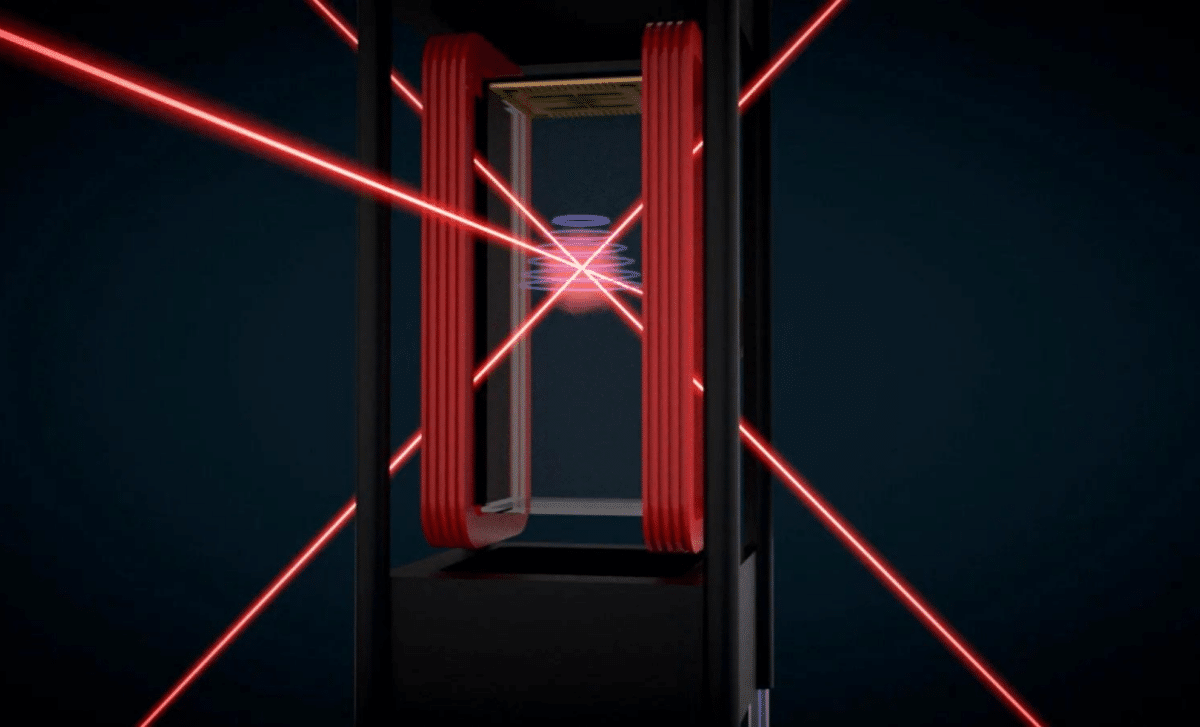
Producing a Bose-Einstein condensate requires remarkable engineering precision. Inside the Cold Atom Lab, scientists first heat strips of rubidium or potassium metal until they release clouds of atoms into an ultra-high vacuum chamber. Powerful lasers then remove energy from those atoms through carefully controlled interactions, reducing their temperature by slowing their motion. Magnetic fields trap the remaining atoms while additional cooling techniques bring them astonishingly close to absolute zero, where quantum effects begin to dominate.
Once these ultracold atomic clouds form, the microgravity environment allows them to remain stable significantly longer than similar experiments performed on Earth. That additional observation time enables researchers to measure extremely subtle changes in atomic behavior with unprecedented precision.
Highlighting the scientific value of these observations, Jason Williams, a JPL scientist affiliated with the Cold Atom Lab, explained:
“Ultracold matter can behave in ways that are not only unexpected but that also enable extremely precise measurements of time, gravity, and motion. The lab has lots of tools—especially with this latest upgrade—to let us probe the nature of the universe.”
These measurements could ultimately improve technologies that rely on ultra-precise sensing, including future navigation systems, gravitational studies, and advanced scientific instruments.
The Latest Upgrade Pushes The Limits Of Quantum Science
The fourth major upgrade to the Cold Atom Lab introduces new hardware that expands both the complexity and precision of experiments conducted aboard the station. Every improvement increases researchers’ ability to manipulate ultracold atoms while exploring conditions that approach the boundary between classical physics and quantum mechanics.
Project manager Kamal Oudrhiri described the importance of this milestone by saying:
“It’s the closest thing we have to controlling the boundary of the quantum world. This new upgrade pushes that boundary even further.”
That statement captures the broader objective of the mission. Each experiment aboard the International Space Station is not simply testing existing theories but extending the limits of what scientists can observe. As researchers continue refining these techniques in orbit, the knowledge gained could influence future quantum computers, next-generation sensors, precision clocks, and entirely new classes of scientific instruments that today remain only theoretical.