NASA Awards More CLPS Contracts, May Send Mars Rover Engineering Model to the Moon – SpacePolicyOnline.com
NASA awarded about $600 million in contracts to three companies today to put robotic landers on the Moon carrying NASA payloads. They are part of NASA Administrator Jared Isaacman’s “Moon Base” effort to send 10 robotic landers to the Moon every year beginning in 2027 during Phase 1 of the Moon Base project. One surprise is that NASA is considering repurposing an existing engineering development model of a Martian rover he calls PROMISE and send that to the Moon as well.
Isaacman and Moon Base Program Manager Carlos Garcia-Galán made the announcements during a virtual event at NASA Headquarters. The awards are part of NASA’s Commercial Lunar Payload Services (CLPS) program where the agency buys services from industry to deliver NASA payloads to the lunar surface. The companies design, develop and launch the spacecraft and are expected to find non-NASA customers to close the business case.
Four CLPS missions have flown so far, one of which was a complete success. Astrobotic’s first mission in 2024 with its Peregrine lander didn’t reach the Moon because of a propulsion failure. Intuitive Machines’s two missions in 2024 (IM-1, Odysseus) and 2025 (IM-2, Athena) reached the surface, but the landers tipped over and only some objectives were met. Firefly Aerospace’s 2025 Blue Ghost Mission-1 was a total success.
Those three companies were the winners today.
- Astrobotic: two awards for Peregrine landers for a total of $297.9 million
- Firefly Aerospace: one award for a Blue Ghost mission for $144.2 million
- Intuitive Machines: one award for a Nova-C class lander for $148.3 million
NASA said the launches will take place “in late 2028,” but Astrobotic’s press release said “by 2028,” Firefly said “in 2028,” and Intuitive Machines (IM) said “no later than 2028.”
Astrobotic has a larger lander, Griffin, that is scheduled to launch this year. Recently acquired by Voyager Space, Astrobotic held an event at its Pittsburgh, PA headquarters earlier this month as they readied to send the lander to NASA’s Jet Propulsion Laboratory (JPL) for pre-launch environmental testing.
Blue Origin also has CLPS contracts using the cargo-only version of their Mark 1 (MK1) Blue Moon lander. Blue Moon MK2 is the version under development for landing crews.
Blue Origin’s first Blue Moon MK1, Astrobotic’s Griffin-1, and IM’s third mission, IM-3, were scheduled to launch in that order this year. At an event on May 26, NASA designated them “Moon Base 1,” “Moon Base 2,” and “Moon Base 3,” respectively.
Just two days later, however, the explosion of Blue Origin’s New Glenn rocket disrupted that schedule. Blue Moon MK1, which will deliver the company’s own Endurance lander, was to launch later this summer on a New Glenn rocket. A new date can’t be set until the launch pad is rebuilt and the root cause of the explosion determined and remedied. Blue Origin CEO Dave Limp reiterated today they plan to resume launches of New Glenn by the end of this year, but Endurance might not be first on the list. The company has many commercial and national security customers as well as NASA.
Astrobotic’s Griffin is scheduled next, followed by IM-3, both later in 2026. All the launch dates are tentative, though. Garcia-Galán said only that “we expect to have at least one mission in ’26 with Astrobotic.”
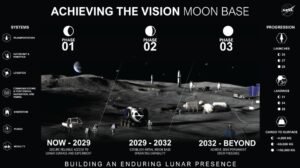
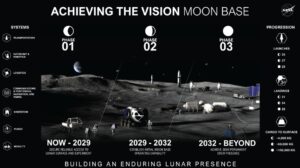
NASA wants to send 10 robotic landers to the Moon per year beginning in 2027 as part of Phase 1 of its Moon Base program. NASA told SpacePolicyOnline.com today that it has five on the books for 2027 at the moment: two from Firefly and one each from Draper, Intuitive Machines, and Blue Origin (NASA’s VIPER rover on a MK1 lander). NASA has the ones announced today on the 2028 calendar, but added they “have the potential to launch earlier.”
The big surprise today was Isaacman’s announcement about potentially launching a repurposed Mars rover to the Moon. Polar Rover for Observation, Mapping and In-Situ Exploration or PROMISE is a hybrid engineering development version of the Mars Perseverance and Curiosity rovers built at JPL. Isaacman didn’t commit to sending it to the Moon, only that NASA is looking at the possibility.
We’re thinking about it. pic.twitter.com/oQosHFPV10
— NASA (@NASA) June 30, 2026
Isaacman often talks about rummaging through the closets at NASA and finding existing equipment that might be useful for other purposes. PROMISE apparently is in that category.
We’ve got this hardware that the taxpayers have invested a lot in, so the question was posed, what if we send it to the Moon? And JPL is great about these good ideas, so no surprise, I mean, they’ve got Moonfall, they’ve got Skyfall, they obviously make great videos [shown earlier], so for PROMISE — it’s existed, you just didn’t know its name and you may not have seen it very often if you weren’t at the Jet Propulsion Laboratory, but it’s probably going to find its way to the lunar South Pole. — Jared Isaacman
One advantage is that it has a nuclear power source — a Radioisotope Thermoelectric Generator or RTG — that would allow it to survive the 14-day bitter cold lunar night. The commercial landers available now don’t and can’t survive very long once the Sun goes down.