July Podcast: Spotlight on Spica
Check out the illustrated version of this podcast on Sky & Telescope’s YouTube channel!
If you checked in for last month’s Sky Tour, you’ll recall that Venus and Jupiter were really putting on a show in the west after sunset. That’s all changed now. Jupiter drops hopelessly out of sight in the early days of July. That leaves Venus to reign supreme in the evening sky.
After the Sun sinks from view, scan the western sky for bright stars. Easiest to spot is Arcturus, very bright and much higher than Venus in the southwest, most of the way to overhead. Over to its right is the Big Dipper, seemingly hanging by its handle in the evening sky.
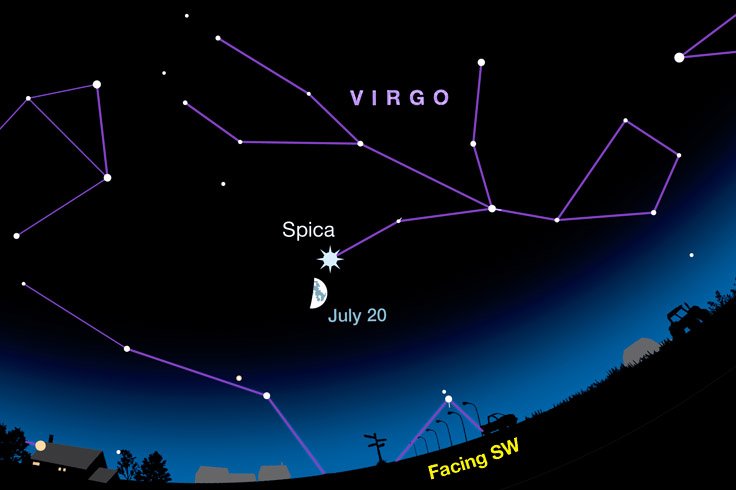
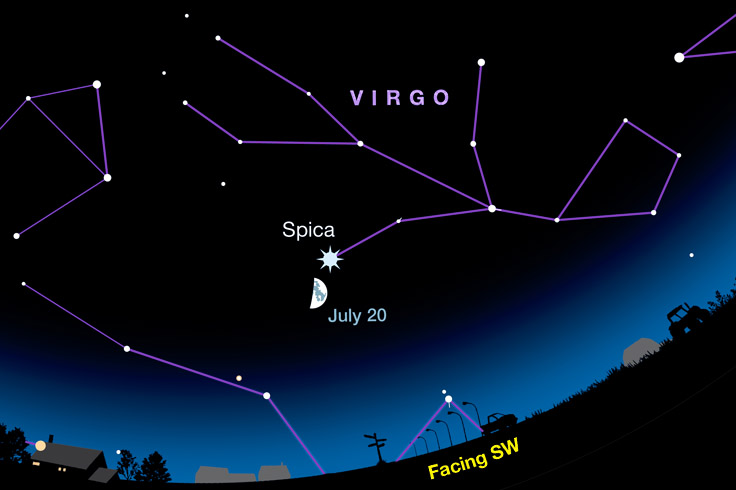
Almost directly below Arcturus, by about three times the width of your clenched fist held at arm’s length, is the icy-white star Spica [SPEE-kuh]. It’s the alpha star in the constellation Virgo, the Maiden. But there’s nothing particularly lady-like about this stellar beacon. Spica is 850 light-years away — but it outshines the Sun by more than 12,000 times with intense, lethally high-energy light. It’s not the kind of star you’d want to have right next door to our solar system.
Sky & Telescope
Spica is one of only four very bright stars periodically occulted, or covered, by the Moon. (The other three are Regulus, Antares, and Aldebaran.) Each star has its own occultation season, during which these coverups can occur monthly for up to several years. Regulus got blinked out in February and again in April. Spica got its turn a year ago on July 13th, but this month you’ll have to settle for a near miss on the evening of July 20th, when they’ll be 3° apart.
And did you know that Spica is represented, along with 26 other stars, on a national flag? To find out which country — and why Spica is on its flag — check out this month’s Sky Tour podcast.
To the left of Spica, by about five times the width of your clenched fist held at arm’s length, is the bright star Antares, the heart of Scorpius, and to its left by 2 or 3 fists is a group of stars in the constellation Sagittarius that are shaped like a teapot. In fact, that’s what astronomers call it — the Teapot. None of the stars in the Teapot is particularly distinctive, but they’re all closely matched in brightness — and that helps the pattern stand out.
There’s much more to see in July’s evening skies — and this month I offer some great tips to enhance your stargazing experiences. So check out this month’s podcast to get a personally guided tour of the beautiful stars of early summer. Thanks for listening!