Final Atlas 5 Amazon Leo mission launches
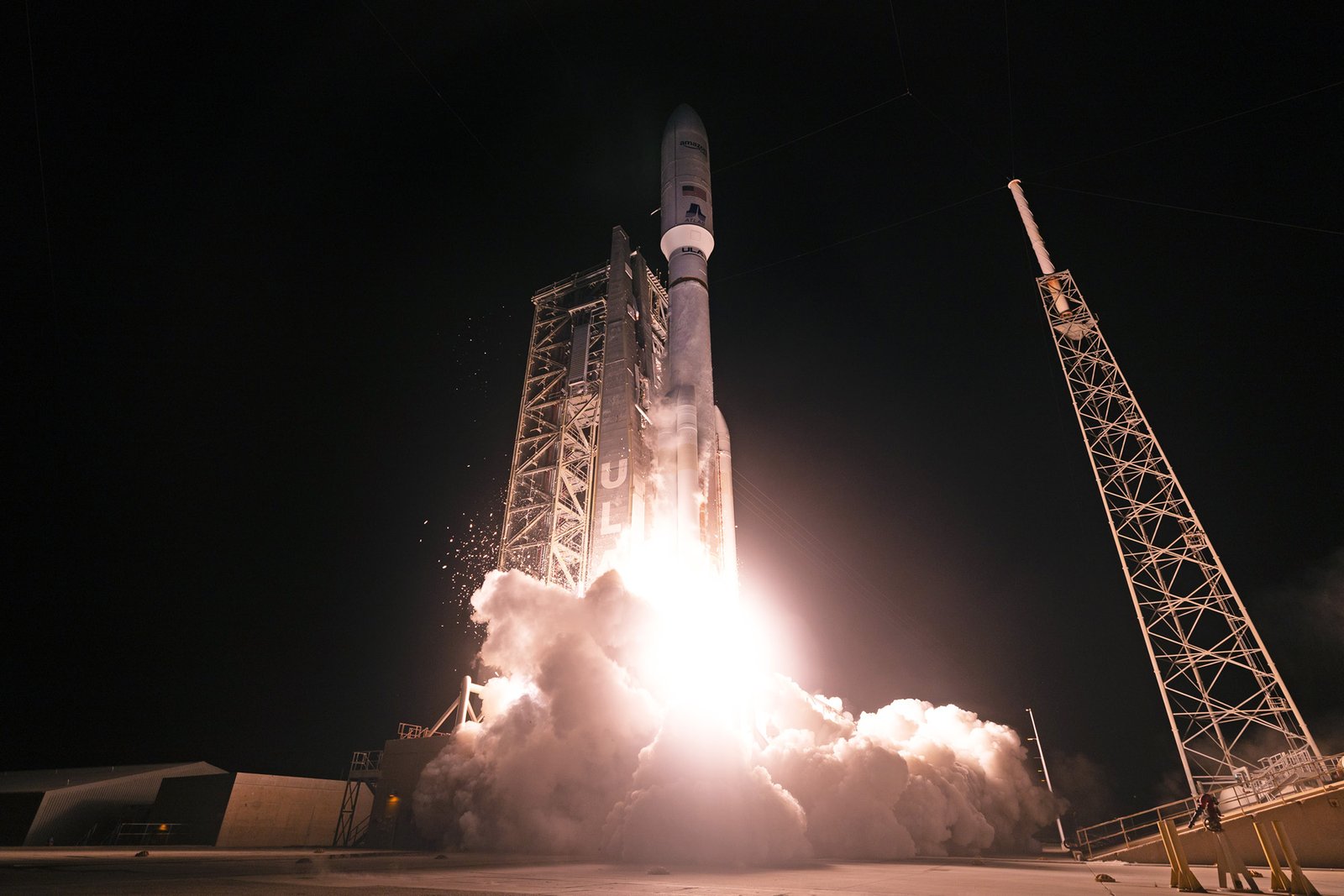
WASHINGTON — An Atlas 5 lifted off July 2 carrying a set of Amazon Leo satellites in the final launch by that vehicle to carry a satellite payload.
The Atlas 5 lifted off from Cape Canaveral Space Force Station at 12:30 a.m. Eastern. The rocket carried 29 Amazon Leo satellites that were deployed starting 21 minutes after liftoff. The deployments were completed 16 minutes later.
With this launch, Amazon Leo has more than 390 satellites in orbit. “Still lots of work ahead — including raising all these new satellites to their assigned altitude — but we’ve completed enough launches for initial service this year, and future missions just add coverage and capacity,” Chris Weber, Amazon Leo vice president, said in a social media post.
The launch was the last of nine Atlas missions that Amazon purchased from United Launch Alliance in 2021 for its broadband constellation, originally called Project Kuiper. The first was used for a pair of prototype satellites in 2023, and the other eight launched operational satellites starting in April 2025.
In 2022, Amazon announced launch contracts to deploy the full constellation, including with ULA for the Vulcan Centaur. Amazon acquired 38 Vulcan launches but has yet to use one given that rocket’s development delays and the availability of the remaining Atlas 5 vehicles.
“Atlas 5 has played a critical role in the early deployment phase for Amazon Leo, launching 224 satellites with a 100% success rate across all eight missions, and we’re excited to build on that foundation with ULA as we transition to Vulcan,” said Melissa Wuerl, Amazon Leo director of launch systems, in a statement.
Vulcan has not launched since a Space Force mission in February that had an anomaly with one of its solid-rocket boosters, and ULA has not disclosed when it anticipates resuming launches. Amazon, though, is gearing up to use the rocket. In addition to Atlas, Amazon has flown three times on Arianespace’s Ariane 6 as well as SpaceX’s Falcon 9.
“With hundreds of flight-ready satellites standing by at the Cape and a new, dedicated vertical integration facility ready to support Leo Vulcan 1 and subsequent missions, we have a clear path to increase launch and deployment cadence, helping us quickly expand network coverage following an initial service rollout later this year,” Wuerl said.
The launch is the final flight of the Atlas 5 carrying satellite payloads. The remaining six Atlas 5 vehicles in storage are reserved for Boeing’s CST-100 Starliner. The schedule for when, or if, those launches will take place is uncertain because of technical problems with Starliner.
With this launch, the Atlas 5 has flown 110 times since its introduction in 2002. All were fully successful except for a 2007 launch for the National Reconnaissance Office in which the Centaur upper stage shut down early on its second burn, leaving the payload in a lower orbit than planned but one that the spacecraft could correct.
The Atlas 5 is the last in a family of vehicles to carry the Atlas name that dates back to the beginning of the Space Age, when Atlas was developed as an intercontinental ballistic missile.