Astronomers Discover Terzan 5’s True Nature
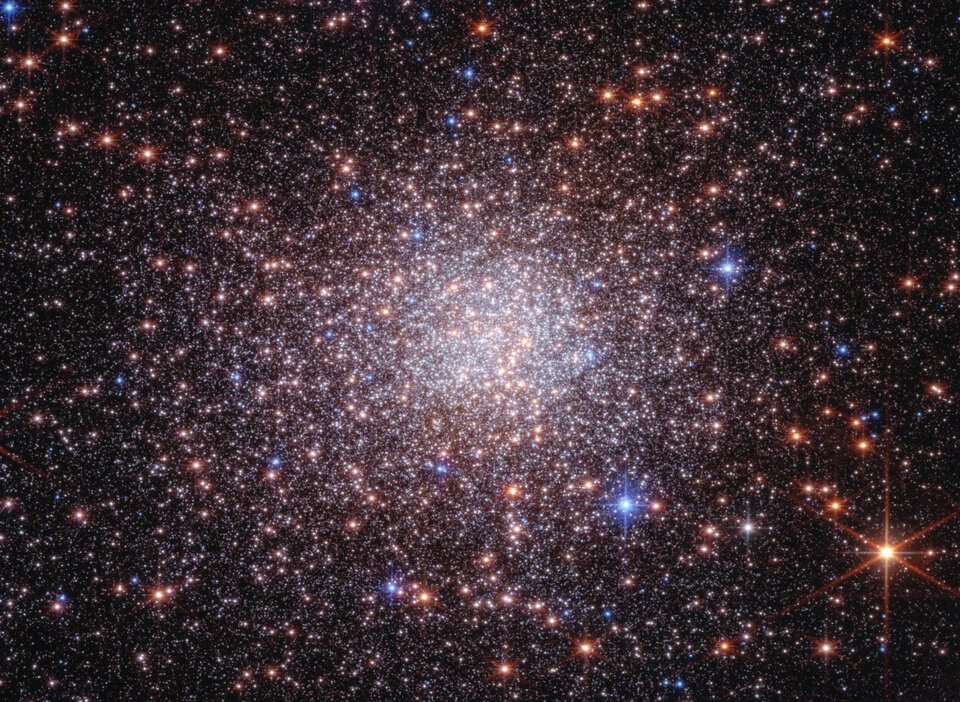
Observations of a distant cluster of stars in our galaxy have defined a new class of objects that turn out to be galactic building blocks. Researchers used Hubble Space Telescope (HST) and the James Webb Space Telescope (JWST) to study the stars that make up Terzan 5, long though to be a globular cluster. What they found puts that cluster into a very rare class of objects that helped form the Milky Way’s core region.
“Webb’s new near-infrared observations, cross-referenced with Hubble’s archival observations, have given us a much clearer picture of the history of Terzan 5,” said Giorgia Zullo, who led the research team studying this oddball cluster. Zullo and her colleagues looked at HST data and images to define the stars that exist in the cluster.
Terzan 5 is most likely the remnant of a much more massive stellar system that initially formed 12.5 billion years ago, when the Milky Way was still coalescing. Somehow it survived the various mergers and never really mixed with the other stars in the bulge. “For some reason, this peculiar clump of stars formed separately from the bulge and was not destroyed as the bulge itself formed,” said Francesco R. Ferraro, a professor at the University of Bologna and principal investigator of the Webb observations. “Terzan 5 is what we now call a bulge fossil fragment because it resembles the primordial clumps that contributed to the formation of the bulge.”
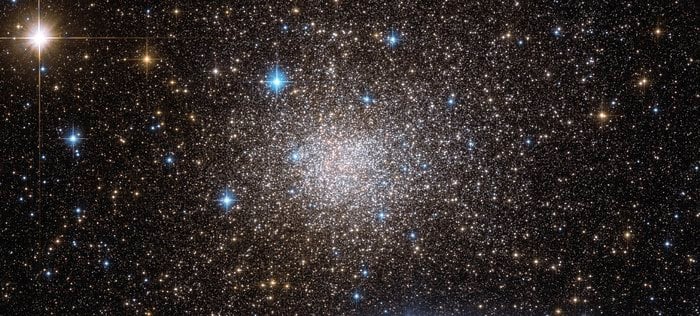
Even more interesting is that Terzan 5 has four different generations of stars, which is not something globular clusters have. Terzan 5’s populations of stars indicate that it went through four distinct eras of star formation. It’s more closely related to clumps of stars that existed in the Milky Way’s earliest epochs. These clumps and their stars spread out and merged to form our galaxy’s central bulge. Terzan 5 didn’t and has, instead, gone on to form new generations of stars and retain its globular shape.
Globulars and Galactic History
The Milky Way’s globular clusters are a tightly woven part of our galaxy’s history. Today we see them swarming around the central bulge. Most have similar ages (dating back around 10-12 billion years), with stars of similar metallicity (that is, chemical elements heavier than hydrogen and helium). Many of those stars are “metal poor”, unlike the Sun, which has a more enriched chemical makeup. The ages of stars in globulars place them at a time when the Galaxy was still forming through mergers and acquisitions of smaller dwarfs. Most of the globulars associated with the Milky Way formed either through regular channels (i.e., star birth creches in clouds of gas and dust in the core) or via the action of mergers.
In a merger, galaxies mingle stars, but the shocks induced by the gravitational interactions between the active participants also set of bursts of star formation. That can result in the creation of globular clusters with stars of similar ages and chemical makeup.
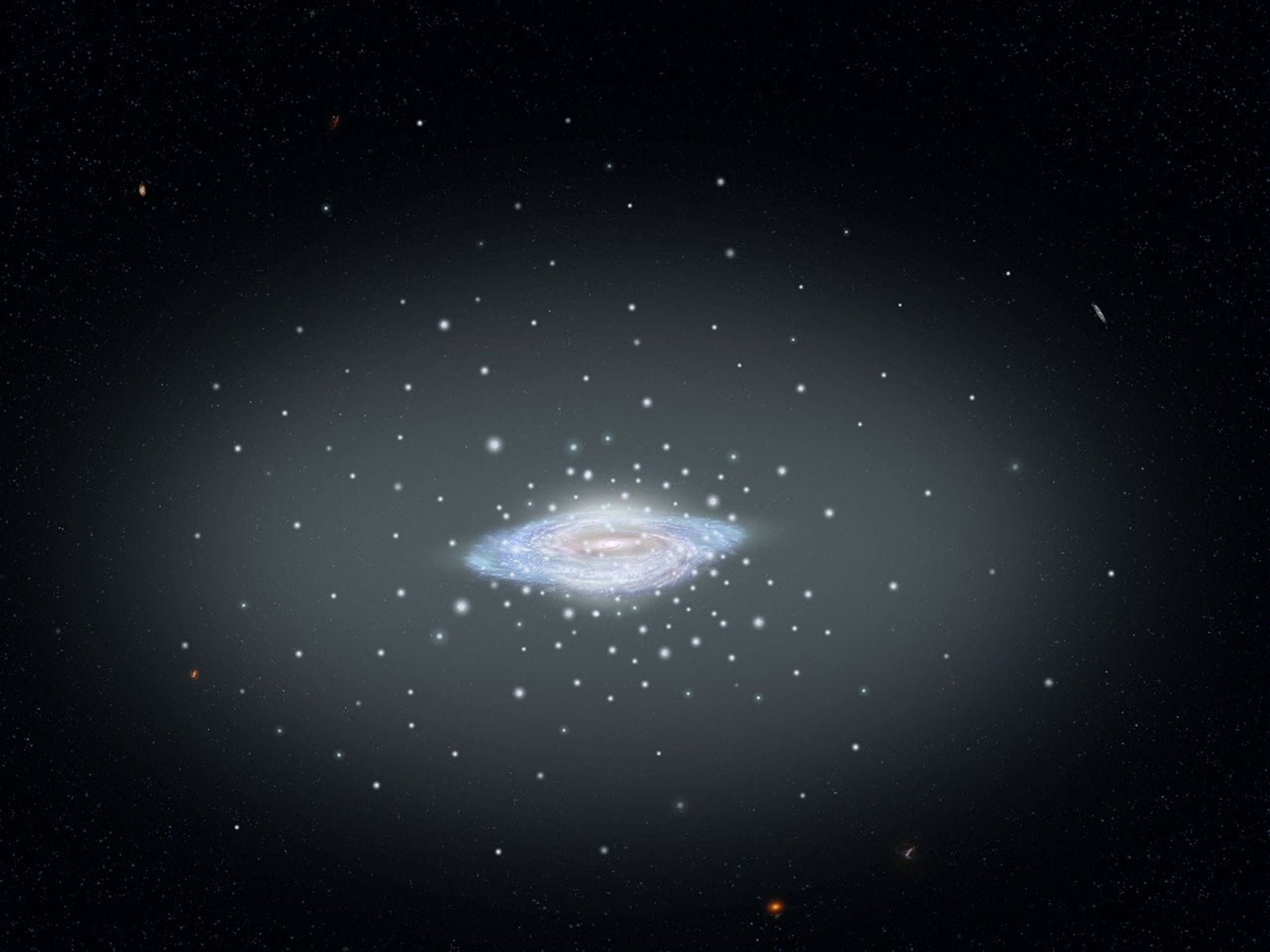 A sketch of our galaxy that shows its globular clusters with respect to distance and position. Credit: NASA, ESA, and A Feild (STScI).
Where Does Terzan 5 Fit?
In previous research, astronomers have come up with the idea of objects called “globular cluster-like dwarfs” to describe star clusters that don’t quite fit the mold of the typical globular cluster. That opens the door to consider other types of clusters that aren’t the same. That brings us to Terzan 5. It isn’t a globular, and it’s not necessarily one of those dwarf objects. Instead, while it does resemble a globular, and it exists within the crowded bulge region of the Milky Way, its distinctly different populations of stars set it apart.
HST and JWST studies show that the cluster has undergone several episodes of star formation. Using studies of stellar metallicity (i.e., the abundance of elements heavier than hydrogen and helium), the science team found a set of stars about 12.5 billion years old. There’s a younger collection of stars that (according to metallicity detections) are about 4.7 billion years old. That’s about the same age as the formation of our Sun.
In addition, there’s evidence of two younger sets of stars that formed in “bursts” up to 3.8 and 2.5 billion years ago. These starburst episodes suggest that Terzan 5 has gone through epochs of self-enrichment as older stars die and younger ones form. The enriched metallicity of the younger stars indicates that the cluster has recycled its components in a kind of “closed system.” It’s possible that this cluster of varied stars has interacted with other sub-structures in the galactic bulge region, which could tell us more about the evolution of the galaxy over the past 12 billion years.
The Next Steps
Studying Terzan 5 isn’t an easy task. It lies in a crowded part of the galaxy and is somewhat hidden by dust. HST was able to get the first highly detailed images of this crowded cluster, despite the heavy dust obscuration. Then, astronomers aimed JWST’s infrared detectors at it. The different star colors and brightnesses allowed the team to classify the stars of Terzan 5 into their different populations.
The combo of JWST data and images from HST also allowed the team to measure very small movements of individual stars, known as proper motions. That let them determine which stars belong to Terzan 5 and which are part of the Milky Way galaxy’s bulge.
?
Future observations of this unique cluster should include more spectroscopic studies, particularly to confirm the ages of its youngest stellar populations. Those studies will also shed some light on the history of star formation in the cluster and the galactic bulge. What astronomers learn from followup studies should open a window on other clusters in and near the galaxy’s core, to see if they, too, played a role in the construction of the Milky Way’s bulge.
For More Information
Webb and Hubble Reveal Relic of Our Galaxy’s Formation
The Multi-age Stellar Populations of Terzan 5 as Revealed by JWST
The Emergence of Globular Clusters and Globular-cluster-like Dwarfs