Amazon, Anduril Partner to Push AI and the Cloud to the Tactical Edge
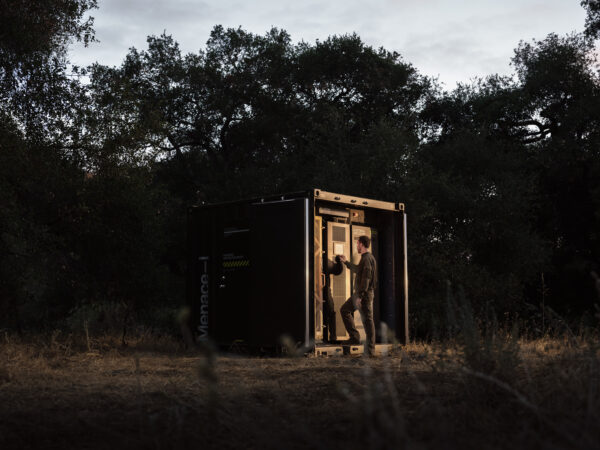
WASHINGTON – One of the Pentagon’s largest cloud services providers is partnering with a rising defense juggernaut to provide high-capacity computing and AI for targeting and sensor fusion in a mobile data center built for austere conditions at the tactical edge.
Amazon Web Services said June 30 it selected Anduril as “a preferred edge provider” for national security and defense. The release did not state whether Amazon plans to partner with more edge providers in the future.
Amazon is the dominant cloud services provider and has close relationships with military and intelligence agencies. It already provides cloud-based services but will now also support Anduril’s Menace-I edge platform.
Anduril and AWS officials spoke on a panel at an AWS public sector gathering here, explaining functions, use cases and what the partnership might mean for military operations in the future.
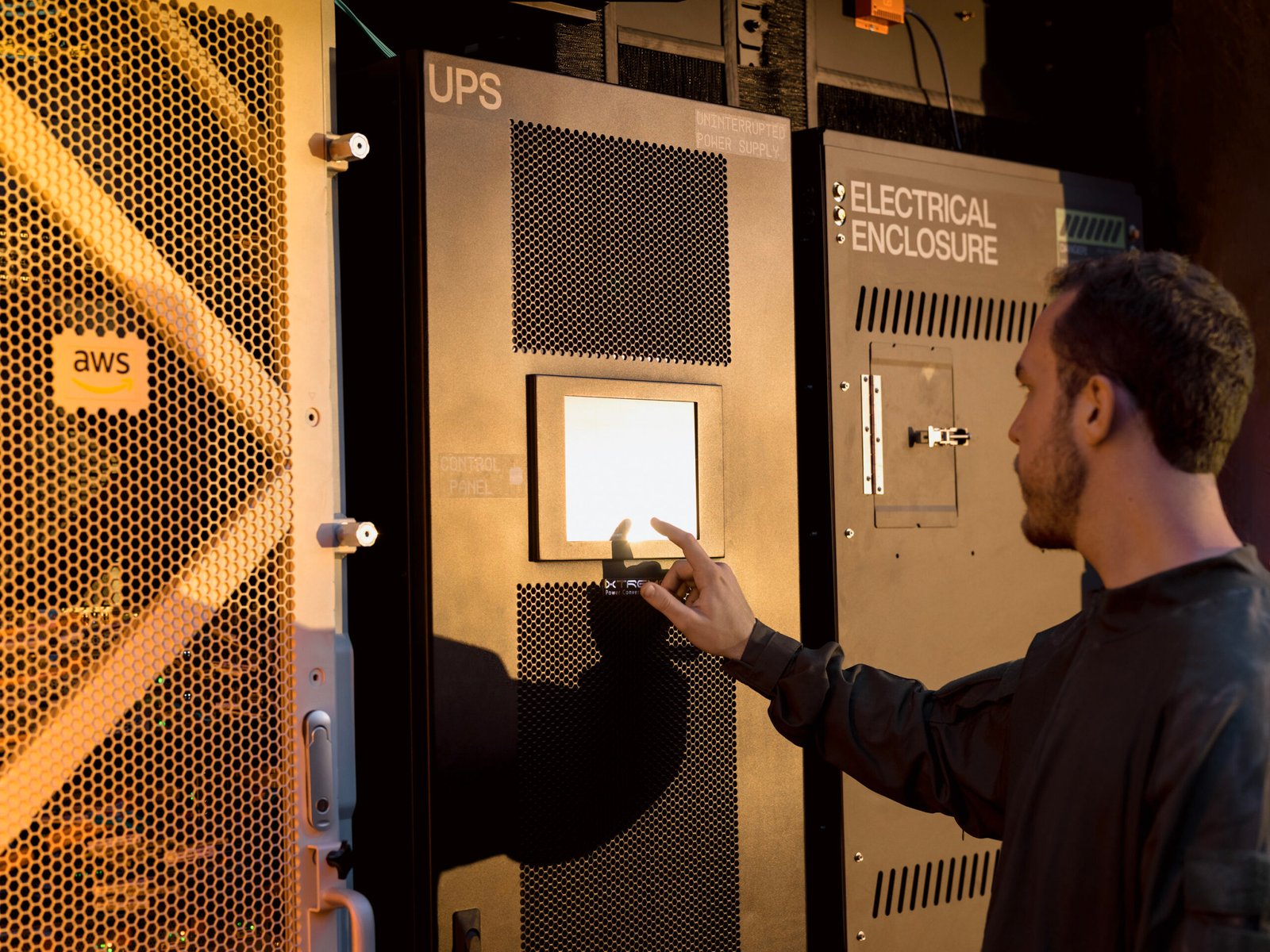
The Anduril mobile data centers will use AWS Outpost, adapted from Amazon’s cloud computing. The idea is to bring the capabilities of a massive local data center to the tactical level in a combat theater.
“What we were able to do together, is to design those systems to run at the extreme tactical edge,” said Tom Keane, Senior Vice President of Engineering at Anduril. “And what’s different about the edge versus a data center? Well, the power is not as nice, there’s no air conditioning, the communications are a little spotty. You may be getting there via a helicopter, or a road train or a C-17.”
Building compact mobile data centers that can perform highly complex, technical processing whether connecting back to enterprise services or operating in a disconnected environment is a rapidly evolving need.
“Military operations typically are quite dynamic with lots of moving pieces. Users need the ability to cross geographic boundaries and access a variety of data sources,” Darrell West, senior fellow for the Center for Technology Innovation at the Brookings Institute wrote in an email to Air & Space Forces Magazine. “It helps to have mobile data centers that provide flexibility and can adapt to a variety of field conditions.”
A typical, complex mission with the F-35 Lightning II might require up to eight human operators and take nearly two days to program, Keane said. But with mobile data center support, aircraft personnel can accomplish the same tasks with two people in about two hours.
When communications are robust and clear, systems can reach to secure data centers in the United States or an allied nation. But those long-distance communications introduce latency, which can mean the difference between hitting and missing a target. And when communications are degraded or denied, systems need to be able to operate regardless.
“There is lower latency in mobile versus distant data centers and that can be important if people are making decisions in real-time,” West wrote. “You don’t want to lose a target if you need military precision in the targeting process.”
Another panelist, Shannon Judd, General Manager at AWS Web Services Worldwide Public Sector Global Partners, gave the example of a defense industry prime contractor needing to rapidly collect, assess and make decisions using flight data. Without AI and cloud-based capabilities at the edge, she said, users have to “back haul,” or send the data for processing at servers hundreds or thousands of miles away in more secure locations. That takes extra time.
The Hardware/Software Combo
Menace-I comes in three variants, each housed within various-sized shipping containers—Core, Command, and Enhanced. The Core is basically an edge-deployed cloud, according to the Anduril website. Command is capable of generating data for sorties, while the Enhanced version can work as an AI factory supporting sensor fusion and targeting.
The main difference between the variants is their size and how many server racks they contain. The Core and Command module can fit one Outpost Rack, while the Enhanced version can support four racks, a person familiar with the technology said. That gives the Core/Command variants 40 to 42 servers per unit and the Enhanced version up to 168, according to the Anduril website.
AWS Outposts uses Ultra Low Latency Racks, which offer faster speeds than standard racks, the same individual told reporters.
An Anduril release noted that Menace has operated over the past three years for more than 50,000 hours of rugged field use. An Anduril representative said Menace is already in use across each of the military branches, and has been used in both exercises and operations, including Operation Epic Fury against Iran.
The Marine Corps validated Menace for sling load movement in August 2025 with the Sikorsky CH-53K King Stallion helicopter.
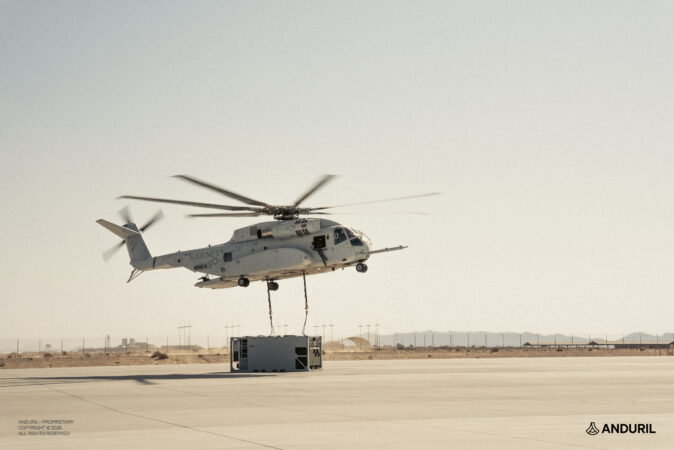
The sling load certification qualifies Menace for mission planning support for fifth-generation aircraft such as the F-35 and F-22 Raptor.
AWS Outposts is being used across the major combatant commands and in Epic Fury, but not always in edge scenarios.
“We have AWS Outposts deployed in the AOR already, but they align to how an outpost is comfortable to be deployed … ,” said Liz Martin, Managing Director of AWS Global Defense. “Which is in the structure with a roof and heating and cooling and power.”
Martin said had the Menace/Outpost combo been available for Operation Epic Fury, users would have had extra capabilities.
“The extra advantage of this as a capability in the AOR would have allowed a little bit more of a proliferation of those capabilities to a wider span of the AOR where mission was taking place that was different than the traditional environment of AWS Outposts,” Martin said.
The Menace hardware has previously hosted Palantir Technologies Tactical Intelligence Targeting Access Node software and capabilities in various scenarios. TITAN is the Army’s first artificial intelligence ground system.