Astronomers Captured a Cosmic Explosion Faster Than Ever Before
A revolutionary rapid-response system has allowed astronomers to observe a gamma-ray burst at millimeter and submillimeter wavelengths within minutes of its discovery, marking the earliest observations ever achieved at these frequencies. The milestone, reported in The Astrophysical Journal Letters, demonstrates how a newly automated observing system at the Submillimeter Array (SMA) on Maunakea can transform the study of the universe’s most violent explosions by reacting before these fleeting events begin to fade.
A Race Against Time Ends With A Historic Observation
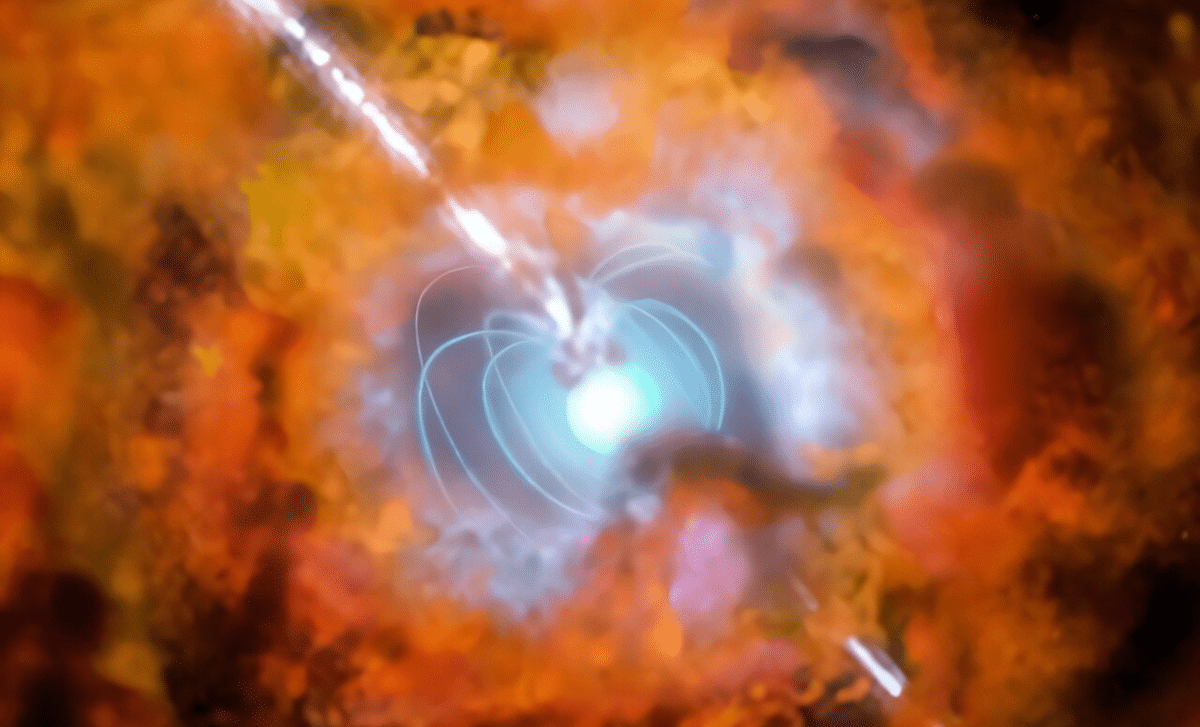
On January 26, 2026, the Submillimeter Array, operated by the Center for Astrophysics | Harvard & Smithsonian (CfA), crossed a milestone that astronomers have pursued for years. Gamma-ray bursts are among the brightest and most energetic events in the universe, produced either when massive stars collapse into compact remnants or when dense objects such as neutron stars merge. These explosions release powerful jets moving at nearly the speed of light, followed by rapidly fading afterglows that contain valuable information about the explosion itself. Until now, optical and X-ray observatories could respond within seconds or minutes, while millimeter and submillimeter telescopes often required hours or even days before beginning observations.
That delay meant scientists regularly missed the earliest stages of these remarkable events. Everything changed when NASA’s Neil Gehrels Swift Observatory detected a gamma-ray burst and automatically issued an alert. Within just 90 seconds, the on-duty operator had been notified, and only four minutes later the SMA was already slewing toward the target. The system operated almost entirely without human intervention, representing a dramatic shift in how the observatory functions.
“It was an incredible thing to watch in real time,” said Garrett Keating, an astrophysicist at CfA and deputy director of the SMA, who led the rapid-response effort. “Being able to react and process data this quickly is a big departure from how SMA usually operates, but it was absolutely critical for capturing an event where minutes matter. This was the first time we had the full system online. We learned a lot from the experience and think we can get the response time down to as little as two to three minutes.”

Credit: The Astrophysical Journal Letters
Images Appeared While The Explosion Was Still Unfolding
The achievement was not limited to moving the telescopes quickly. Within 13 minutes of the original gamma-ray detection, the array was already collecting observations, while an automated processing system simultaneously transformed the incoming interferometric data into scientific images. This represented a dramatic leap compared with traditional millimeter astronomy, where researchers often wait hours before usable data products become available. Producing images from an interferometer is significantly more complicated than capturing photographs with a conventional telescope because the system combines signals from multiple antennas spread across a large area. The automated pipeline removed one of the biggest bottlenecks in transient astronomy, allowing scientists to evaluate the event almost immediately after it was detected.
“With interferometry, we don’t get direct images from the telescope,” explained Ranjani Srinavasan, interim director of the SMA. “Usually that process takes a long time.”
The new workflow reduced the overall response time by roughly two orders of magnitude compared with the traditional pace of millimeter and submillimeter observations. Instead of arriving long after the brightest phases had disappeared, astronomers were finally able to watch the earliest moments of the afterglow, when the physical conditions around the explosion evolve at their fastest pace.

Credit: The Astrophysical Journal Letters
Why The Discovery Matters For The Future Of Astronomy
The research, published in The Astrophysical Journal Letters, demonstrates far more than a successful engineering upgrade. Early millimeter observations provide a unique way to measure the energy of gamma-ray bursts, the structure of their jets, and the properties of the material ejected during these extraordinary explosions. Scientists have long recognized that these wavelengths contain information unavailable in optical or X-ray observations, yet technical limitations prevented them from observing the events before they faded. The new system removes one of the largest obstacles, allowing researchers to investigate the earliest stages of some of the universe’s most extreme phenomena with unprecedented speed. Follow-up observations conducted two days after the initial detection confirmed that the source had faded as expected, strengthening the conclusion that the SMA had indeed captured the transient afterglow rather than a distant background galaxy.
“The SMA’s new capability is a game changer for the field,” said Edo Berger, professor of astronomy at Harvard and a co-author of the study.
Preparing For A Flood Of Future Cosmic Alerts
This breakthrough also marks the beginning of the SMA Sub/millimeter Program to Rapidly Investigate Novel Time-domain Sources (SMA SPRINTS), an initiative designed to deliver rapid follow-up observations of transient events across the changing sky. The program combines the array’s new rapid-response system with the upgraded wSMA wideband capabilities to provide greater sensitivity and flexibility as astronomy enters an era of continuous sky monitoring. That preparation is becoming increasingly important because upcoming facilities, including the Vera C. Rubin Observatory’s Legacy Survey of Space and Time (LSST) and the future Nancy Grace Roman Space Telescope, are expected to generate enormous numbers of transient alerts every night. Without automated systems capable of responding almost instantly, many of these short-lived events would remain only partially understood.
“This new capability opens a unique window into the physics behind some of the most powerful stellar explosions,” said Tanmoy Laskar, assistant professor of physics and astronomy at the University of Utah and a co-author of the study. “With the SMA, we can now probe the structure and composition of the ejecta in unprecedented detail, bringing us closer to understanding how these explosions launch their powerful jets.”
The successful demonstration suggests that rapid-response millimeter astronomy is no longer an experimental concept but a practical scientific tool. As more next-generation observatories begin scanning the sky around the clock, the ability to react within minutes may become one of the defining capabilities of modern astronomy, revealing the earliest moments of the universe’s most powerful explosions with a level of detail that was previously out of reach.