A Star’s Death Throes Involves a Lot of Kicking
Imagine being nudged again and again by thousands of tiny shoves, each one barely perceptible alone, until they add up to a steady drift in one direction. That is roughly the fate of a star like our Sun as it nears the end of its life. A new model from Caltech astrophysicist Jim Fuller suggests dying stars do not simply fade quietly into white dwarfs. They get kicked there, one chaotic burst of escaping gas after another.
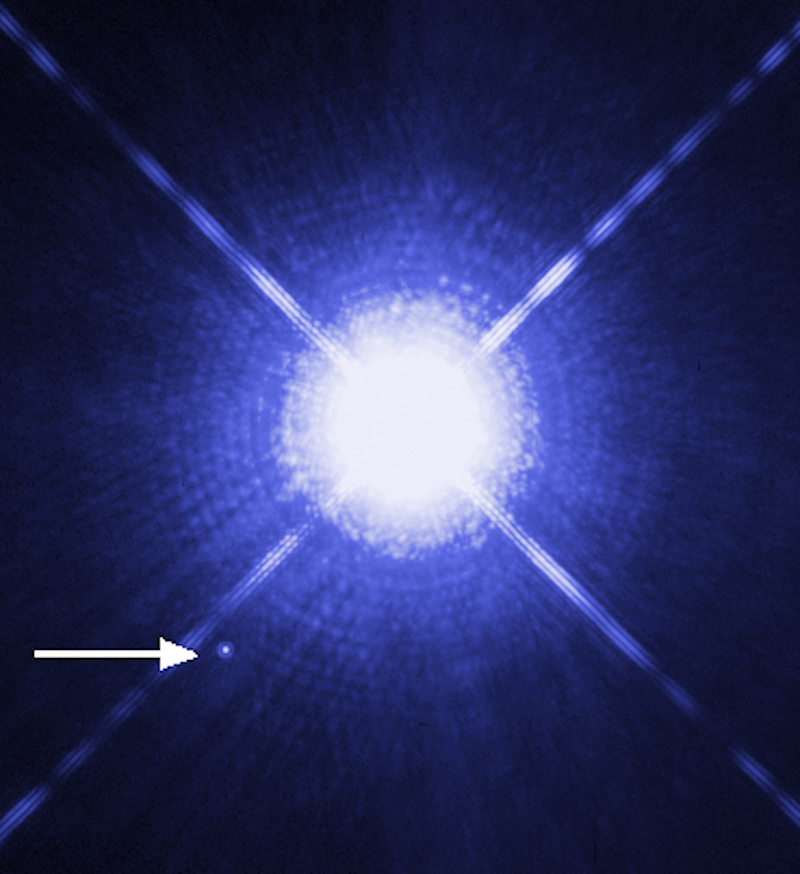
Sirius A with its faint white dwarf companion Sirius B (see arrow at lower left) the kind of pairing a stellar kick could unbind or drive to collision (Credit: NASA, ESA, H. Bond (STScI))
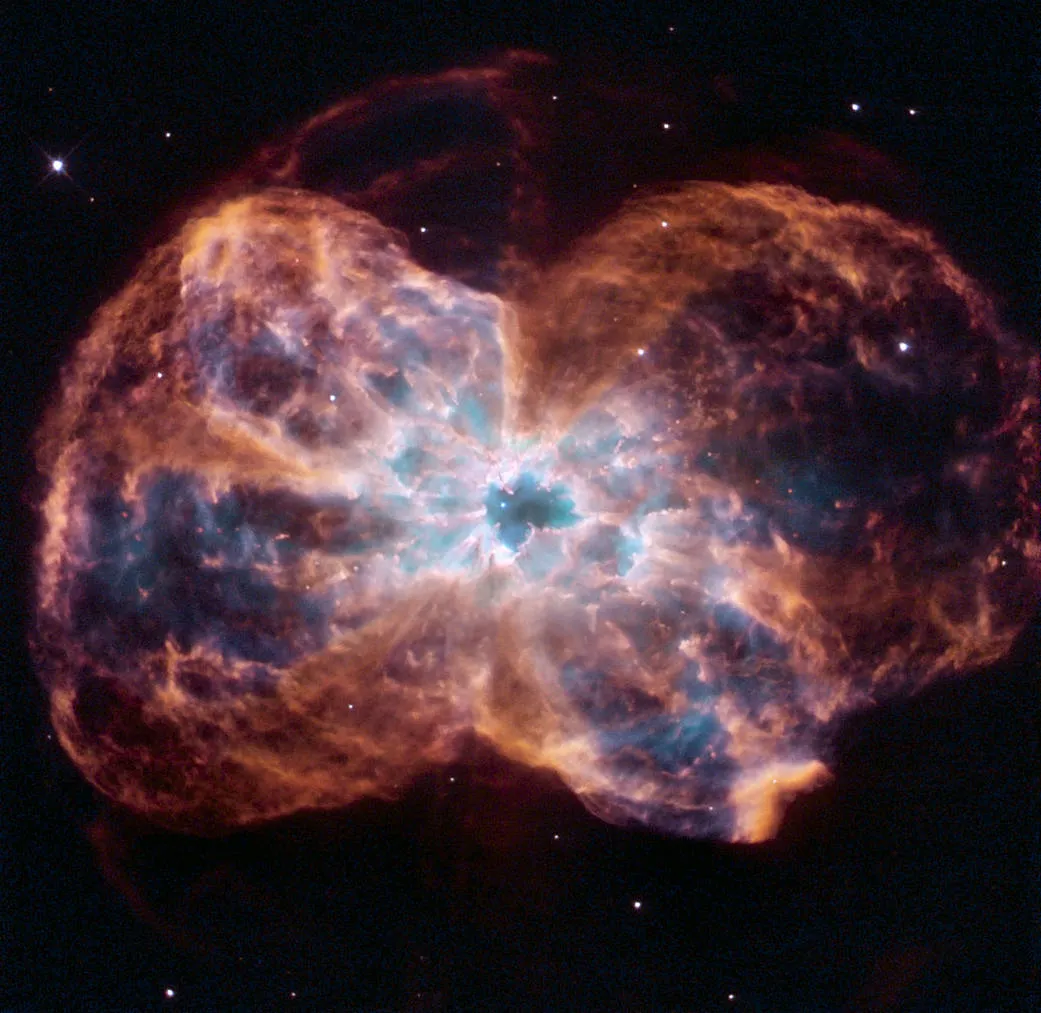
The standard picture of a star like the Sun growing old is a familiar one. It swells into a red giant, sheds its bloated outer layers into space, and leaves behind a dense, slowly cooling core known as a white dwarf. What Fuller’s model adds is motion. As the dying star loses mass, it does not do so evenly in all directions. Instead, blobs of material are ejected asymmetrically from its surface in a chaotic, bubbling process, and every ejection gives the star a small recoil in the opposite direction, exactly as Newton’s third law would predict. Over the star’s final hundreds of thousands of years, Fuller calculates this happens roughly ten thousand times, each kick nudging the star at a pace of only a few metres per second, slower than a gentle jog.
No single kick amounts to much. But because the direction of each ejection is essentially random, the cumulative effect behaves like a random walk, the same statistical process that governs a coin flipped over and over to decide which way to step. Run that process ten thousand times and the star ends up displaced from where it started, even though no individual nudge was aimed anywhere in particular. Fuller’s calculations suggest the star is left drifting at roughly a kilometre a second in some random direction, a final, accidental inheritance from its own death throes.
The idea helps resolve a puzzle that had troubled astronomers for years. Caltech’s Kareem El-Badry had previously noticed that widely separated binary star systems become rarer once one of the pair turns into a white dwarf, as though something were prising the two stars apart. Fuller’s kicks supply a tidy explanation since, a white dwarf’s recoil speed exceeds the orbital speed holding a wide binary together, the kick is enough to unbind the pair entirely, sending the stars their separate ways.
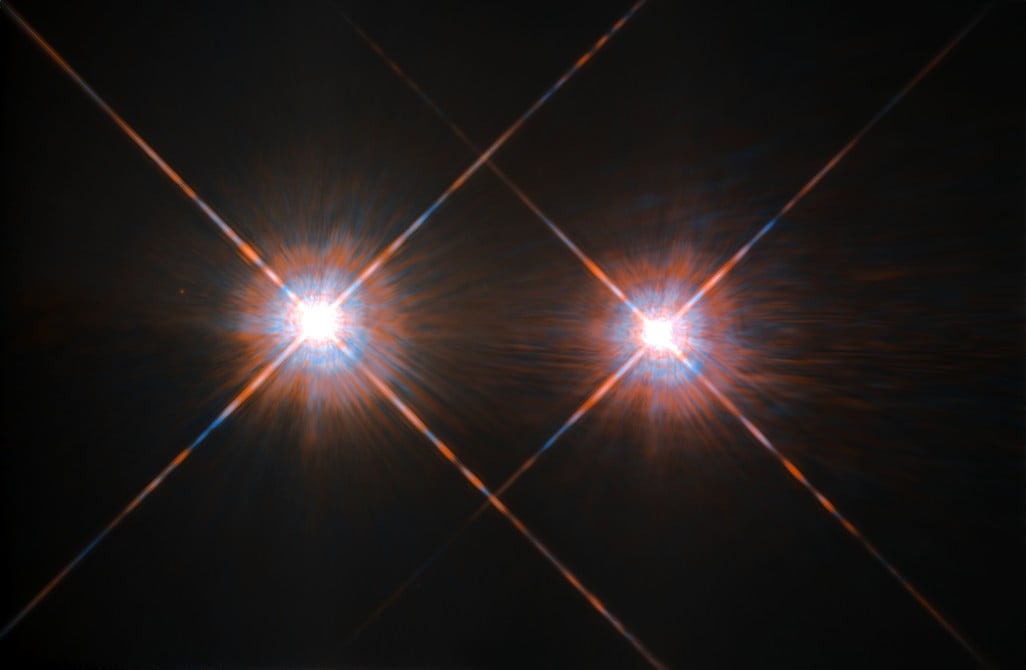
The nearest binary star Alpha Centauri, as photographed by the Hubble Space Telescope (Credit : ESA/Hubble)
The model also makes a striking prediction of its own. In tighter binary systems, the same kicks that fail to break two stars apart might instead drive them together, triggering a collision and a stellar explosion. That gives observers something concrete to look for, a violent signature that would let astronomers test whether Fuller’s chaotic, kicking stars really do behave as the mathematics suggests.
Imagine being nudged again and again by thousands of tiny shoves, each one barely perceptible alone, until they add up to a steady drift in one direction. That is roughly the fate of a star like our Sun as it nears the end of its life. A new model from Caltech astrophysicist Jim Fuller suggests dying stars do not simply fade quietly into white dwarfs. They get kicked there, one chaotic burst of escaping gas after another.
Sirius A with its faint white dwarf companion Sirius B (see arrow at lower left) the kind of pairing a stellar kick could unbind or drive to collision (Credit: NASA, ESA, H. Bond (STScI))
The standard picture of a star like the Sun growing old is a familiar one. It swells into a red giant, sheds its bloated outer layers into space, and leaves behind a dense, slowly cooling core known as a white dwarf. What Fuller’s model adds is motion. As the dying star loses mass, it does not do so evenly in all directions. Instead, blobs of material are ejected asymmetrically from its surface in a chaotic, bubbling process, and every ejection gives the star a small recoil in the opposite direction, exactly as Newton’s third law would predict. Over the star’s final hundreds of thousands of years, Fuller calculates this happens roughly ten thousand times, each kick nudging the star at a pace of only a few metres per second, slower than a gentle jog.
No single kick amounts to much. But because the direction of each ejection is essentially random, the cumulative effect behaves like a random walk, the same statistical process that governs a coin flipped over and over to decide which way to step. Run that process ten thousand times and the star ends up displaced from where it started, even though no individual nudge was aimed anywhere in particular. Fuller’s calculations suggest the star is left drifting at roughly a kilometre a second in some random direction, a final, accidental inheritance from its own death throes.
The idea helps resolve a puzzle that had troubled astronomers for years. Caltech’s Kareem El-Badry had previously noticed that widely separated binary star systems become rarer once one of the pair turns into a white dwarf, as though something were prising the two stars apart. Fuller’s kicks supply a tidy explanation since, a white dwarf’s recoil speed exceeds the orbital speed holding a wide binary together, the kick is enough to unbind the pair entirely, sending the stars their separate ways.
The nearest binary star Alpha Centauri, as photographed by the Hubble Space Telescope (Credit : ESA/Hubble)
The model also makes a striking prediction of its own. In tighter binary systems, the same kicks that fail to break two stars apart might instead drive them together, triggering a collision and a stellar explosion. That gives observers something concrete to look for, a violent signature that would let astronomers test whether Fuller’s chaotic, kicking stars really do behave as the mathematics suggests.