July 2026: What’s in the sky this month?
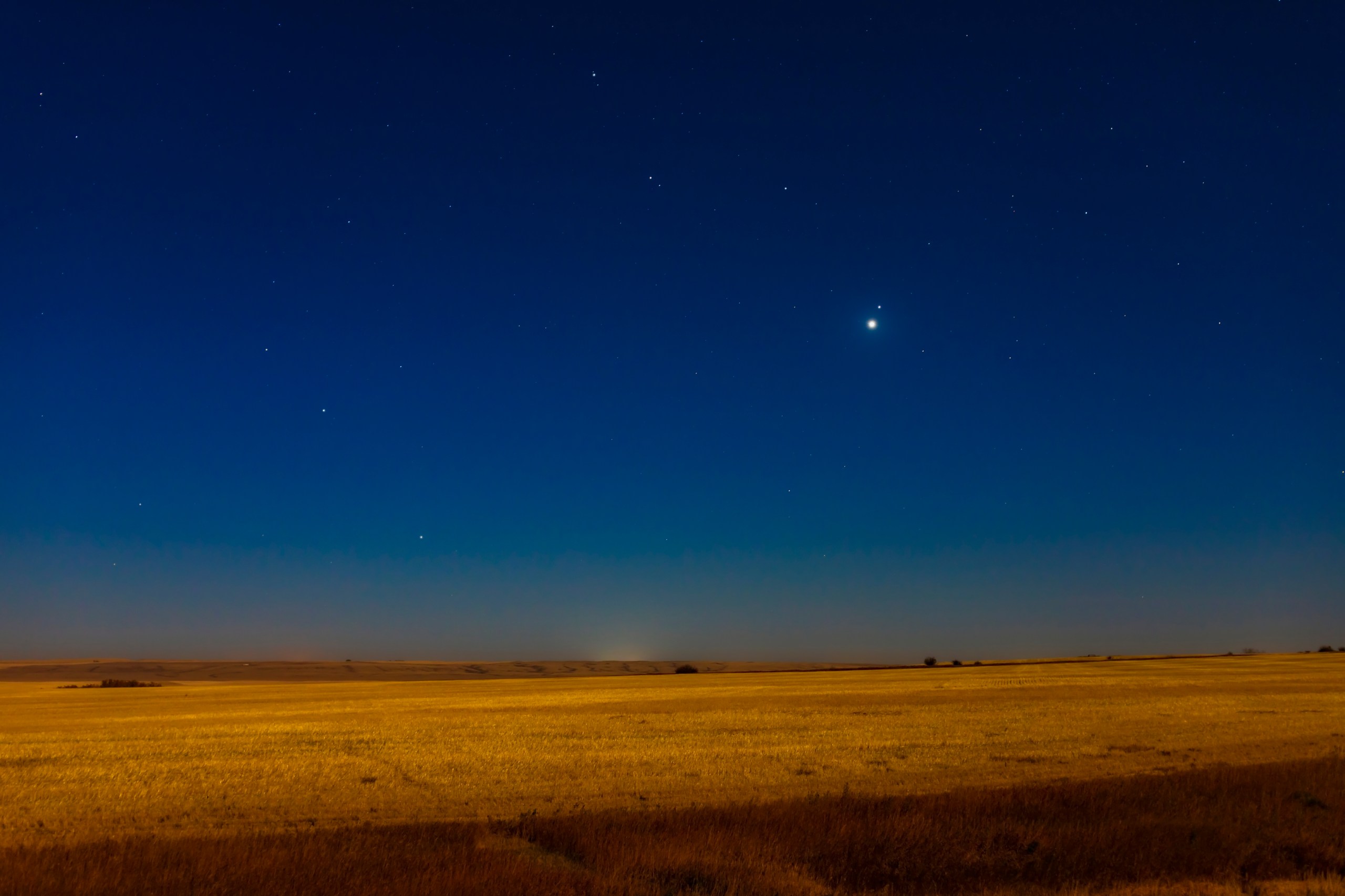
A conjunction of Venus and Regulus easily catches the eye to the right of center in this 2020 photo. A similar conjunction occurs this month, with their positions swapped. Credit: Alan Dyer
Venus and Jupiter remain visible in the evening sky soon after sunset early in July, although Jupiter fairly quickly drops out of sight. In the morning sky there’s lots of planetary action: Saturn rises earlier now, placing it in a dark sky for a couple of hours. Neptune joins it in Pisces. There’s a wonderful conjunction between Mars and Uranus on July 4. If you’ve never seen Uranus before, this conjunction makes it easy. Finally, Mercury rounds the Sun and reappears in the morning sky in the last few days of the month. Let’s dive into some details.
Jupiter lingers briefly above the western horizon at magnitude –1.8 soon after sunset. Catch it quickly because it drops out of view within an hour of sunset by July 5. On that evening, Jupiter stands 5° high 30 minutes after sunset. After that it becomes increasingly more difficult to follow as it heads toward solar conjunction, which occurs July 29.
Venus stands roughly 20° high a half hour after sunset in early July and is easy to spot. On July 1, shining at magnitude –4.1, it is 21° from Jupiter — draw an imaginary line from Venus down toward the sunset glow to search for Jupiter in early twilight.
Regulus, the brightest star in Leo the Lion, becomes easily visible an hour after sunset. On July 1, Venus and Regulus are less than 9° apart; by the 8th, they’re within 1.5°. They remain close for two nights, then Venus moves farther east of the bright star.
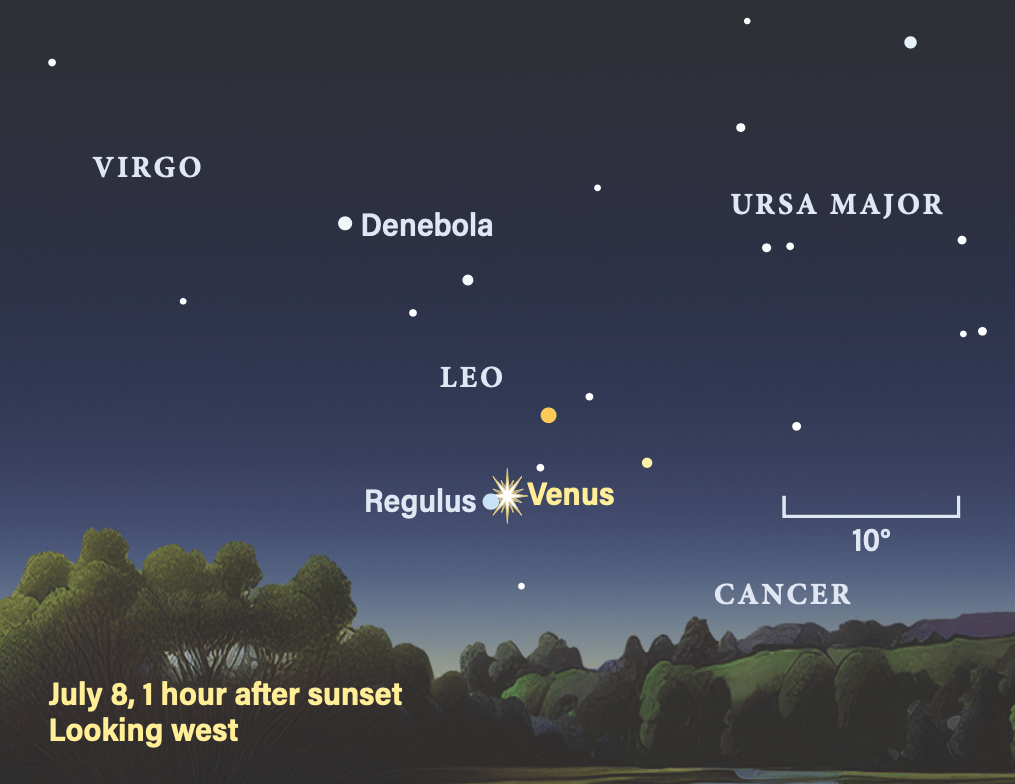
A nearly three-day-old Moon greets Regulus on July 16, just 1.5° south of the star. Venus lies some 8° east of the Moon. On the following evening, the Moon stands 6.2° southeast of Venus.
Venus continues across southern Leo, reaching the border with Virgo on the 31st, by which time its dazzling glow has increased to magnitude –4.3.
Track Venus with a telescope and follow its changing phase and apparent size. On July 1, the disk of Venus appears 16″ wide and 69 percent lit. The phase diminishes to 56 percent by July 31, with the disk spanning 21″ — a hint that Venus is getting closer to us. It will reach greatest eastern elongation next month.
Neptune is the next planet to appear in the night sky; it waits until after midnight local daylight time on July 1, half an hour before Saturn rises. In early July, it’s best to try to spot the distant planet after 3 a.m. local daylight time, when it stands more than 20° high in the eastern sky.
You can use the Great Square of Pegasus to find Neptune. The left side of the square, from Alpheratz to Algenib in the southeast corner, spans 14°. Neptune lies nearly 15° due south of Algenib, an easy distance to estimate using these two stars.
Neptune requires binoculars or a telescope to spot. It shines below naked-eye visibility at magnitude 7.7. Scan with a pair of binoculars south of Algenib to find a parallelogram of four stars: 27, 29, 30, and 33 Piscium, each glowing near 5th magnitude.
These four stars lie about 7° southeast of the Circlet of Pisces. Look about 6° northeast of the parallelogram, which packs well inside the field of view of 7×50 binoculars, for a tiny circlet of fainter stars shining between 7th and 9th magnitude. Two 7th-magnitude stars are most obvious, and there’s an additional interloper of similar magnitude with a bluish hue. That’s Neptune.
Through a telescope, Neptune is little more than a tiny, 2″-wide disk, barely perceptible. During July it shows little motion — it’s stationary on the 7th, and about a week later its westerly motion resumes as it moves away from the tiny circlet of stars.
Saturn starts the month at magnitude 0.7 and lies midway across Pisces, near its southern edge. It’s visible in the predawn sky all month, rising about 1 a.m. local daylight time on the 1st. By the 31st, it rises two hours earlier. On July 7, Saturn lies 7° southeast of a nearly Last Quarter Moon. Saturn moves very little against the background stars and reaches a stationary point on the 27th.
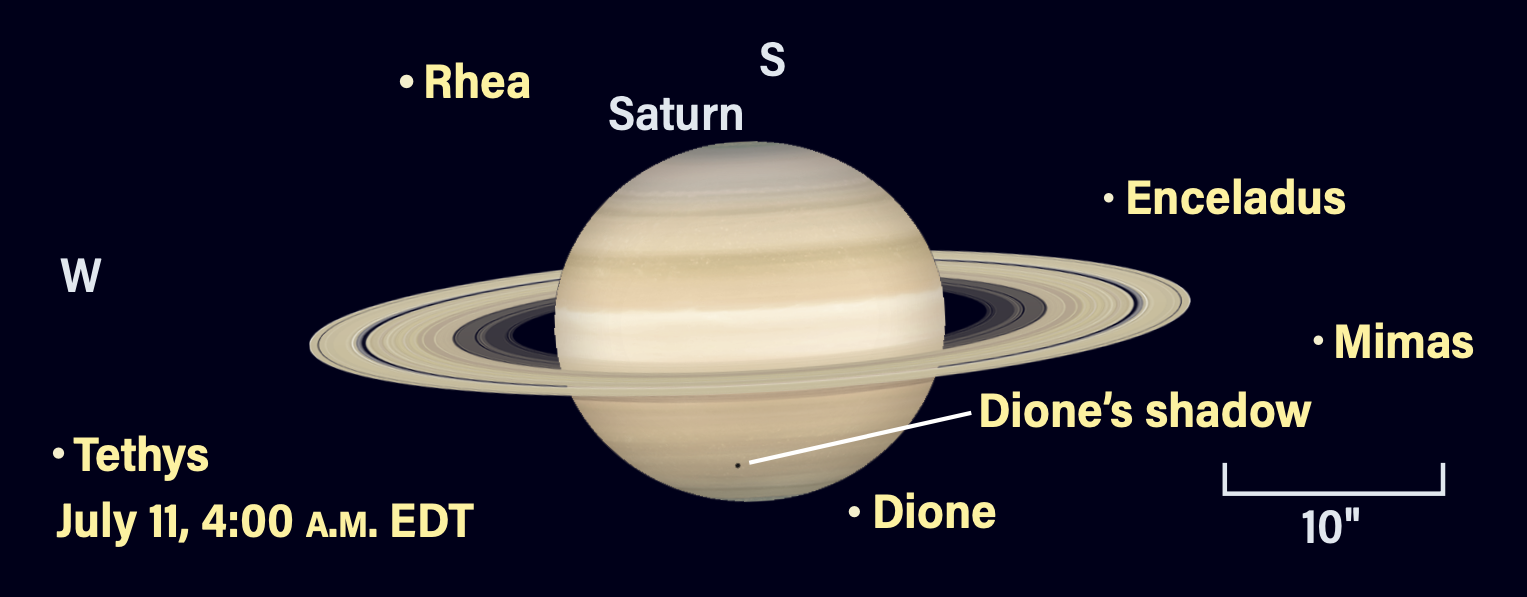
After 4 a.m. local daylight time, with Saturn more than 30° above the southeastern horizon, it’s a good time to catch the planet’s many moons. Titan is the brightest, orbiting every 16 days. You’ll find it close to Saturn on the 4th and 5th, when it lies just northeast and northwest of the planet, respectively, and again on the 20th and 21st. It lies southwest and then southeast of Saturn on the 12th and 13th, respectively, and again on the 28th and 29th.
Iapetus reaches western elongation late on July 16. This faint moon varies its brightness as it orbits, as its opposing bright and dark faces turn earthward. At western elongation, it’s two magnitudes brighter than at eastern elongation. This places Iapetus near 10th magnitude, a relatively easy target — except for its 8.5′ distance from the ringed planet. Coincidentally, Titan is at eastern elongation the same night, standing about 3′ east of the planet as it rises around local midnight. Its position is a useful ruler to estimate where Iapetus is located, some three times that same distance, but to the west of Saturn.
For a challenge: Video may capture a series of transits and shadow transits of the tiny saturnian moon Tethys, while Dione also undergoes shadow transits. These are only detectable via video capture with careful processing. Note that Dione passes due north of the planet overnight on July 10/11 and 21/22, close to the times of its shadow transits.
Uranus and Mars are both within Taurus the Bull. They make a remarkably close conjunction on July 4 some 5° southeast of M45, the Pleiades star cluster. Mars is easy to spot, shining at magnitude 1.3 and located 8° northwest of Aldebaran (magnitude 0.9), Taurus’ brightest star, which sits adjacent to the Hyades cluster.
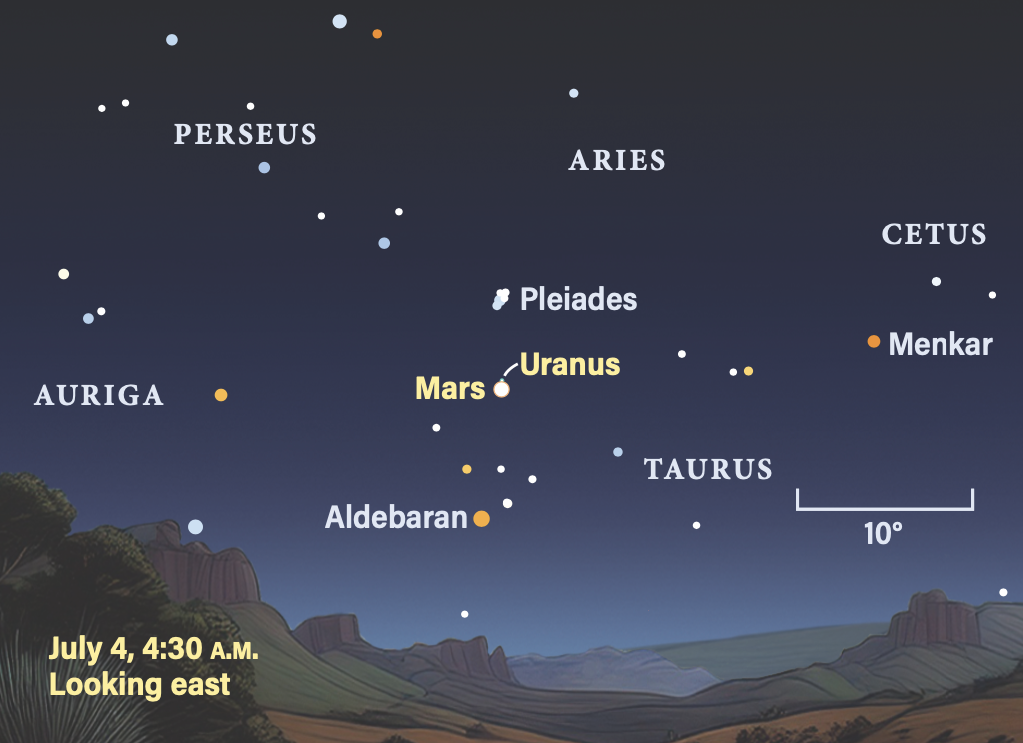
On July 4, Aldebaran and Mars are above the eastern horizon by 4:30 a.m. local daylight time, just as the first vestiges of twilight appear. Grab binoculars and look 9′ northwest of the Red Planet for a bluish-green object glowing at magnitude 5.8. That is Uranus. A dim (8th-magnitude) star lies between the pair. The following day, Uranus lies 45′ due west of Mars, and the gap quickly widens further as the days pass.
Uranus moves slowly eastward against the background star field during July, standing about 1.5° south of 37 Tauri (magnitude 4.4) early in the month. By July 31, Uranus is 1.8° southeast of 37 Tau. Through a telescope, the planet shows a tiny, 4″-wide disk.
On July 11, a waning crescent Moon joins Mars and Uranus; our satellite is just under 5° north of Mars.
The Red Planet continues east across Taurus, passing 5° due north of Aldebaran on the 14th. By the end of July, it has reached a point just over 3° northwest of Zeta (ζ) Tauri, the southern horn of the Bull.
Spanning a mere 5″ — not much wider than Uranus at present —Mars is too tiny to present any surface features. That opportunity will occur in the last two months of 2026, as the distance between Earth and Mars finally begins to shrink. It will reach opposition in February 2027.
Mercury pops up in the morning sky in late July. Following its July 12 inferior conjunction, Mercury moves briskly west of the Sun, although it remains quite faint until July 28, when it reaches magnitude 1.0. An hour before sunrise, look for Mercury level with Pollux about 3° above the horizon in the east, separated by 11.5°. The star Betelgeuse in Orion stands 9° high, roughly due east. By July 31, Mercury brightens to magnitude 0.5, becoming easier to spot as it is a few days away from its greatest western elongation.
Rising Moon: Lunar time travel
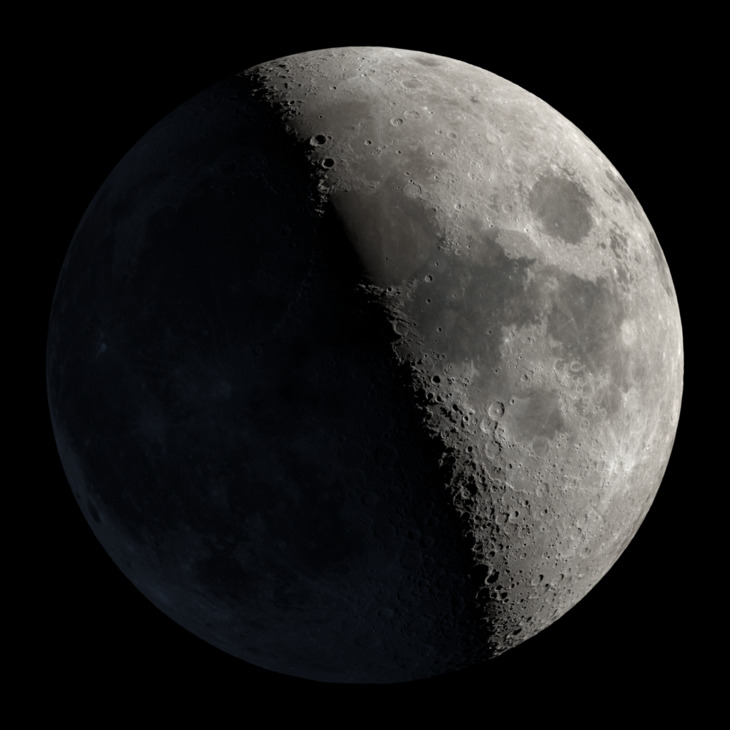
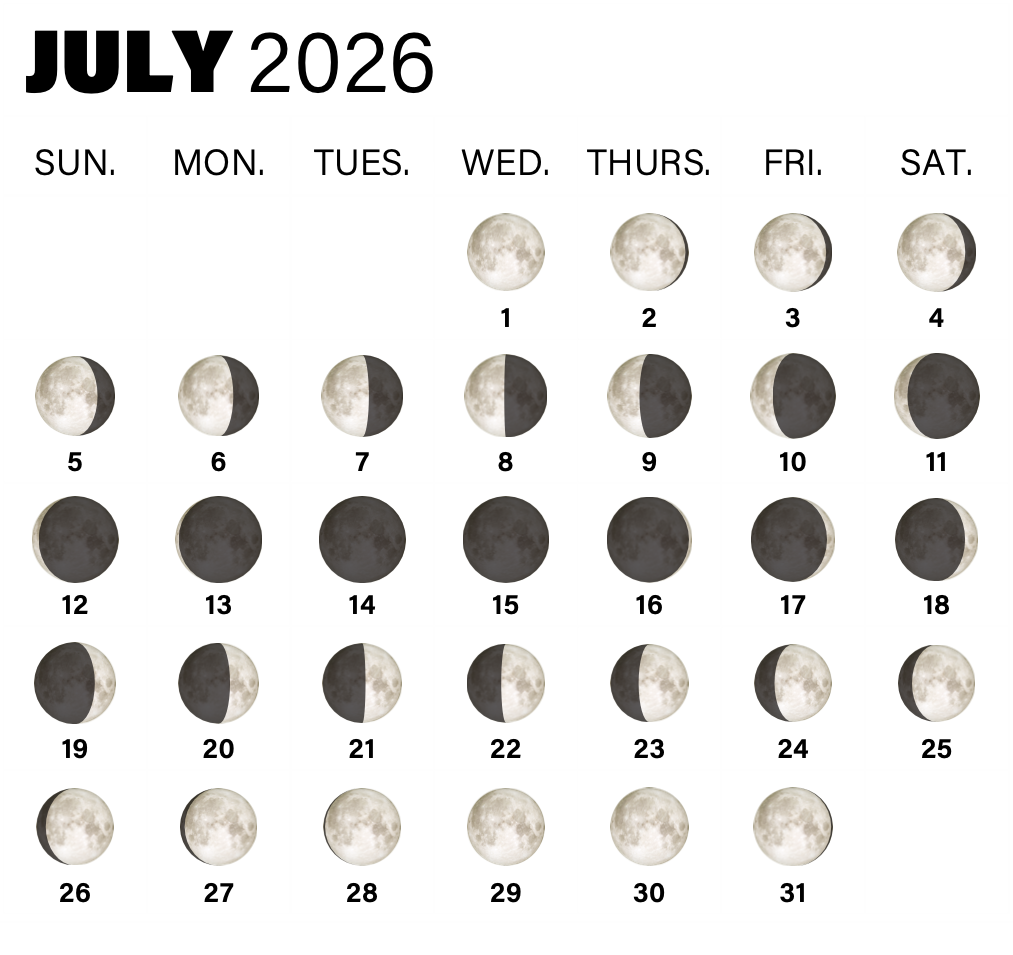
Imagine the anticipation of looking at the Full Moon on June 29, 1969, and thinking we’d land there in three weeks. The evening crescent appears on the 16th, ratcheting up the excitement night after night until the landing on July 20.
This month, we can time travel back to 1969 as the exact same lunar phase appears in the July 20 sky.
An exact match?! Yes, if you’re not counting seconds: The Moon’s phases repeat on the same calendar date every 19 years, called a Metonic cycle. Although known by the Babylonians, Greek astronomer Meton also realized the importance of this period around 430 b.c.e., registering it in Western classical texts. Now, we are precisely three Metonic cycles (a total of 57 years) after Apollo 11: With 29.530589 days from Full Moon to Full Moon, times 235 months, times 3 cycles, we get 20,819.065 days or 57.038356 years since July 20, 1969.
Other features of the lunar orbit (e.g., node crossing, perigee) don’t quite line up, meaning that eclipses won’t always repeat on a Metonic cycle. And some 19-year blocks have an extra leap day compared to others, which can throw the date off by one day. But if you remember when there was a Full Moon on your birthday, without blinking you know the next one is 19 years after that, and so on.
Check out Tranquillity Base at the eyepiece, located near the southwestern rim of the Sea of Tranquillity, with only 1.6 hours difference in lighting compared to that seen by Eagle on the exact same day of the year.
Related: Astronomy magazine July 2019 issue: Apollo 11 50th anniversary
Meteor Watch: Midsummer lull
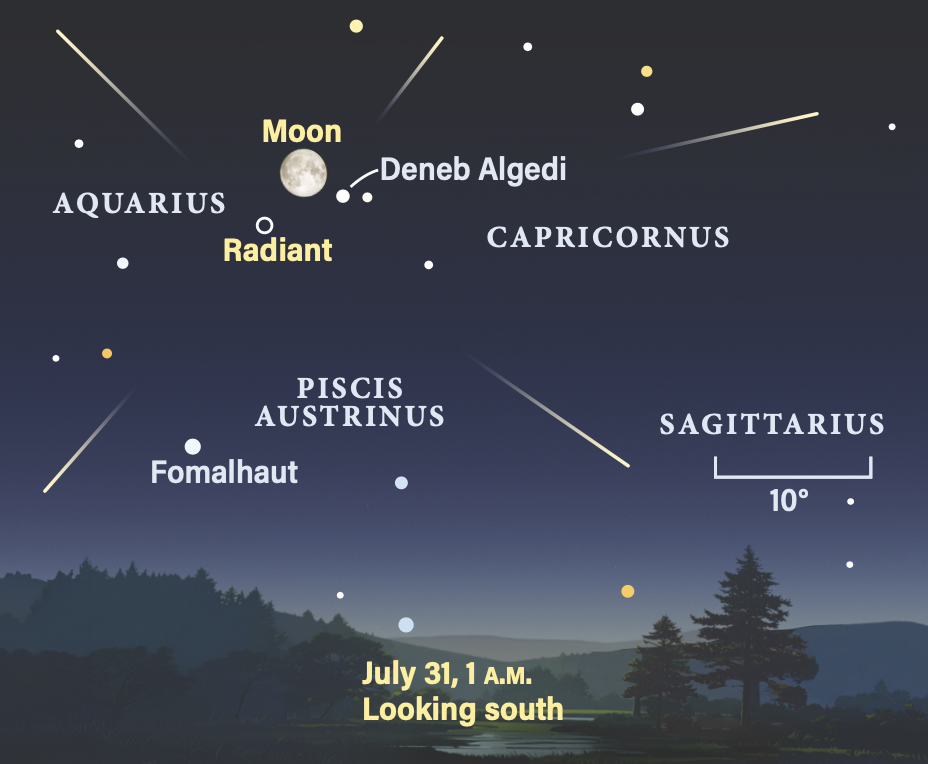
Some minor meteor showers occur toward the end of July. The very minor Alpha Capricornid shower peaks — if you can call it that — July 30, with a zenithal hourly rate of 5. This is barely different than the sporadic rate of background meteors. Slightly stronger is the southern arm of the Delta Aquariids, peaking the same date. With both constellations and their respective radiants reaching highest elevation in the southern sky soon after midnight, it would be a fair time to spot some of these shower members — except for the brilliant nearly Full Moon at the Capricornus/Aquarius border.
The middle of July is when the Perseid meteor shower starts; it ramps up slowly throughout the rest of the month. Since mid-July is moonless, it’s a favorable time to go meteor hunting while you spend some time viewing Saturn and waiting for Mars to rise. Next month promises much better after this lull, with a New Moon coinciding with the Perseids’ peak.
Comet Search: Climbing up the edge
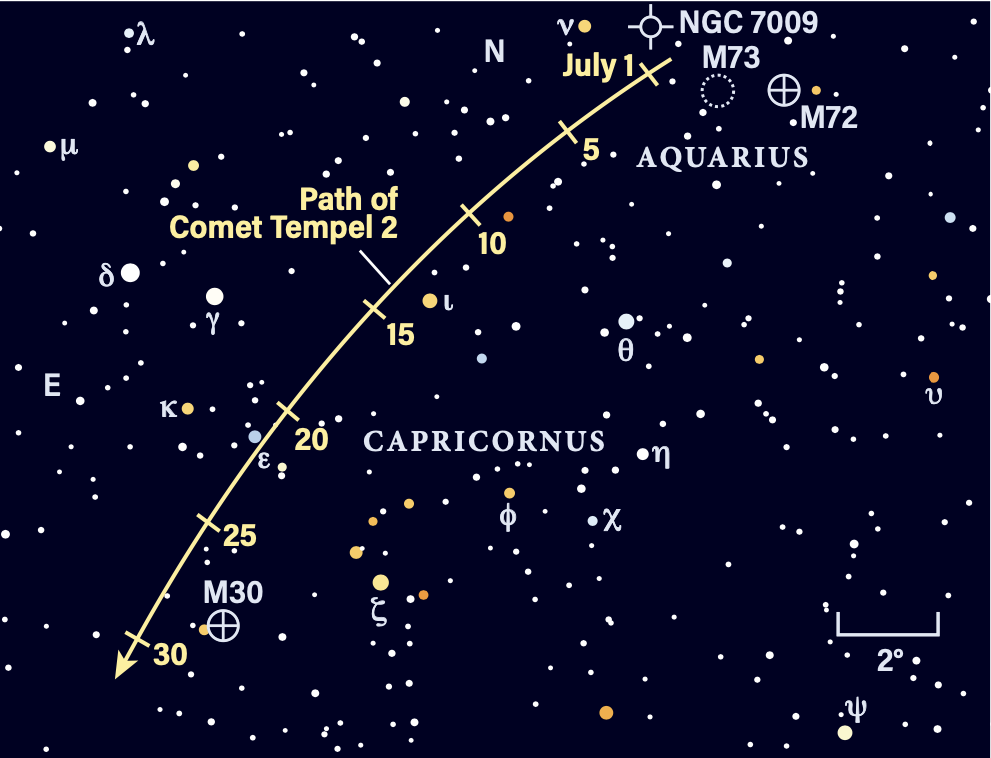
Short-period Comet 10P/Tempel (also called Tempel 2) will be closest to the Sun Aug. 2, and to Earth a couple of days later, skimming just outside Mars’ orbit. The combo delivers the brightest apparition since 1967, reaching into 7th magnitude. Plan to hit dark skies during the midmonth New Moon period to get your best look at this interplanetary dirty snowball.
With the comet diving south through Capricornus, ensure you have a good southern horizon and wait until midnight to catch Tempel 2 above as much atmospheric haze as possible. Based on previous apparitions, the comet should sport a bright, condensed central knot and short, broad fan.
Rapid changes occur from the 18th to the 22nd. It’s not the comet, it’s us. Imagine a picture of a comet taped to the wall beside a door — as we (Earth) pass through that plane (the doorway), we see the comet edge-on, its fan becoming a knife’s-edge. The gas tail remains hidden behind the dust from our perspective, with no apparent anti-tail this time. Luckily, the First Quarter moonset occurs earlier than average thanks to its extra-low declination.
History tells us that Tempel 2 might jump a magnitude in brightness after perihelion, but the night-to-night transformation of its plane-crossing is the better treat.
Locating Asteroids: Digging for light and darkness
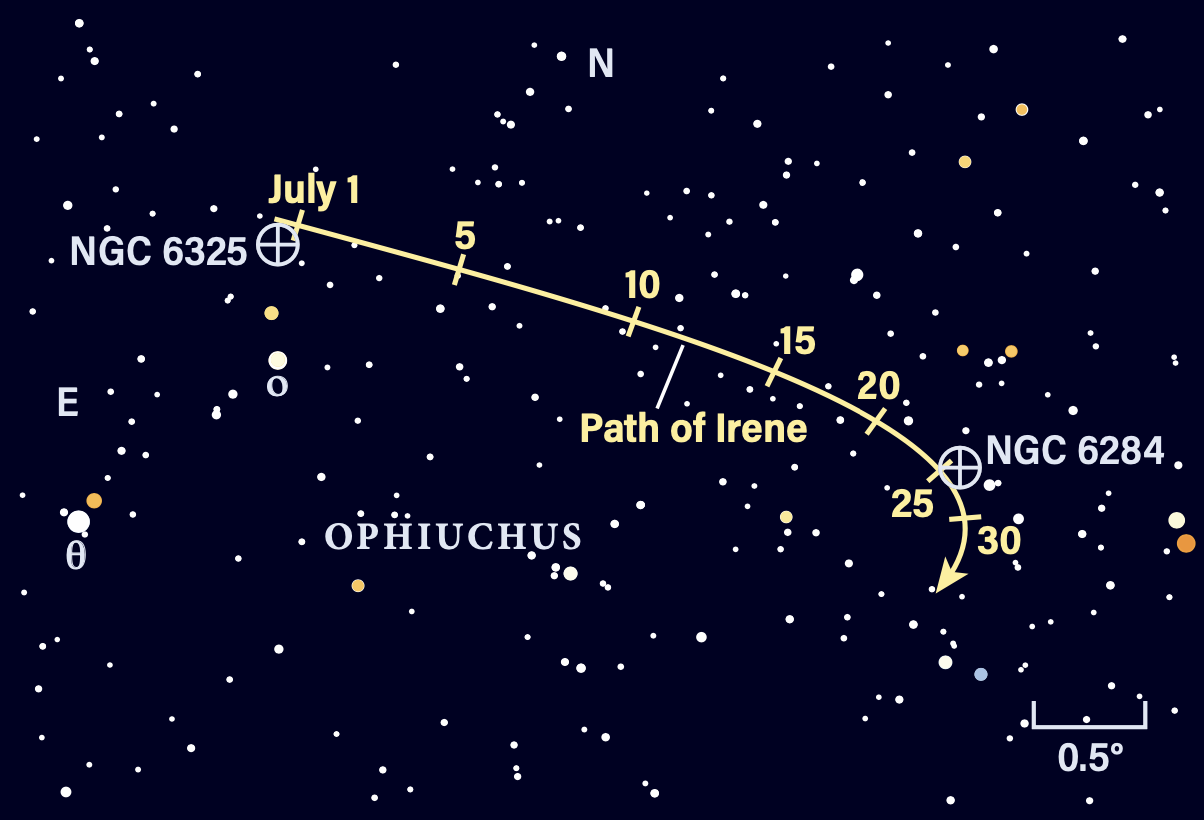
When the brightest main-belt asteroids lie outside the window of our short summer nights, it’s time to push our envelope. From the suburbs, a 6-inch scope will help peer through the veil of city light to reach our 10th-magnitude target, 14 Irene. Jump to 3rd-magnitude Theta (θ) Ophiuchi, the first decent star northeast of Antares, then shift west to Omicron (ο) Oph.
Thanks to all the dust in this zone near the heart of the galaxy, many stars have been hidden from view, leaving recognizable patterns of 7th- to 9th-magnitude dots to orient ourselves at the eyepiece. Place three or four in a logbook page, figure out which dot on Irene’s trajectory is suspect, then return another night to confirm it.
Our background is the belly of the Dark Horse Nebula, also called the Prancing Horse. From a country sky, this is a different wonderland not of swirling nebulae, but of cozy shrouds and pinpoints. The prominent empty space to the southeast is the hindquarters, which taken alone is called the Pipe Nebula. Be slow and deliberate, enjoying the tunnels and ink spots as you slowly move your scope around. Globulars NGC 6284 and 6325 bookend Irene’s journey this month, appearing as bloated, hazy stars.
Irene may seem an uncommon name for a Greek goddess, yet she was the goddess of peace — a sentiment suggested by discoverer John Hind in 1851.
Star Dome
The map below portrays the sky as seen near 35° north latitude. Located inside the border are the cardinal directions and their intermediate points. To find stars, hold the map overhead and orient it so one of the labels matches the direction you’re facing. The stars above the map’s horizon now match what’s in the sky.
The all-sky map shows how the sky looks at:
midnight July 1
11 p.m. July 15
10 p.m. July 31
Planets are shown at midmonth