NASA awards nearly $600 million in lunar lander missions
WASHINGTON — NASA has selected three companies to fly four robotic lunar lander missions worth nearly $600 million as part of its lunar base ambitions, as the agency weighs sending a spare Mars rover to the moon.
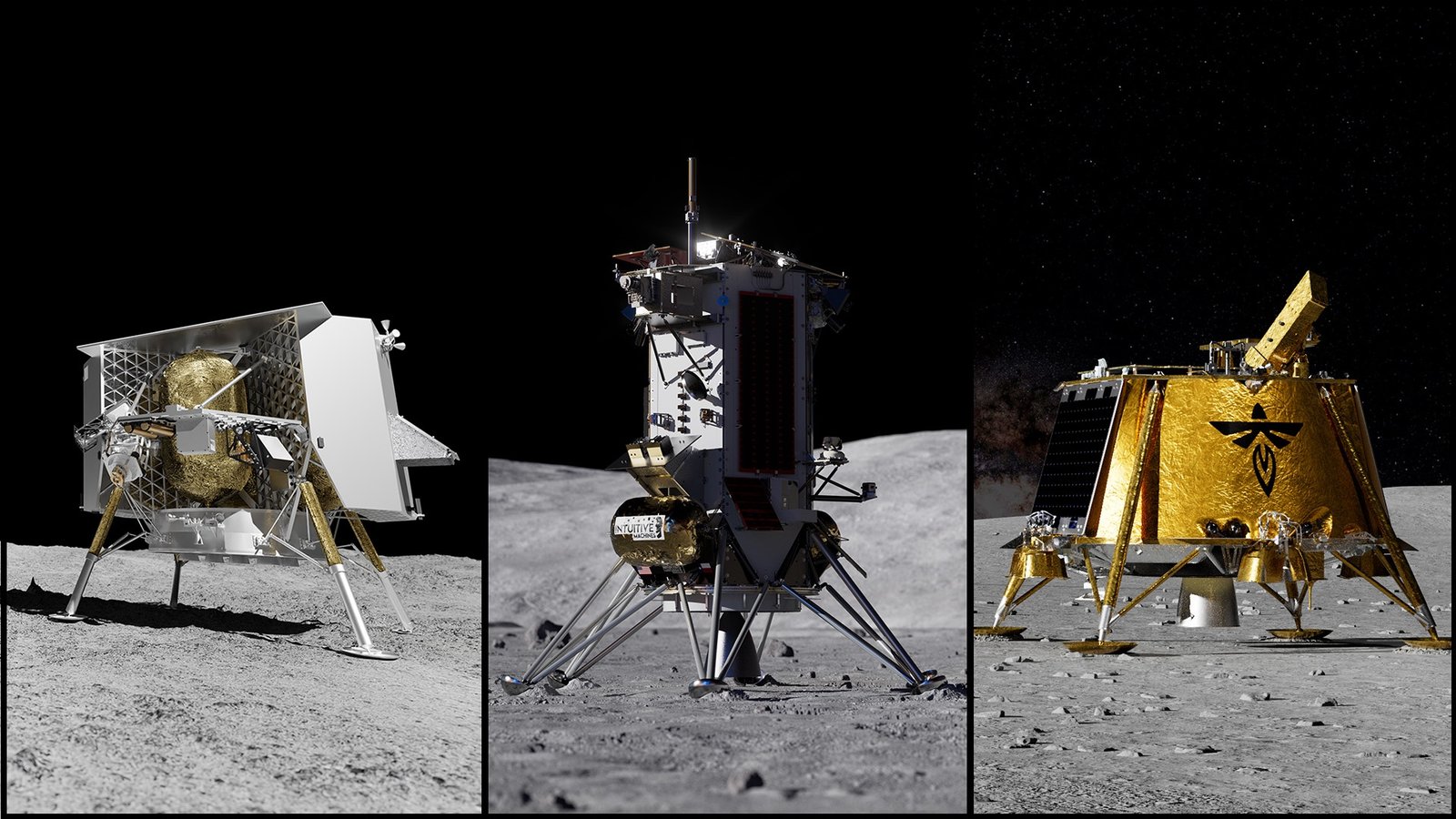
During a June 30 online presentation, NASA officials announced they selected Astrobotic Technology, Firefly Aerospace and Intuitive Machines for lander missions scheduled for late 2028 with a combined value of $590.4 million.
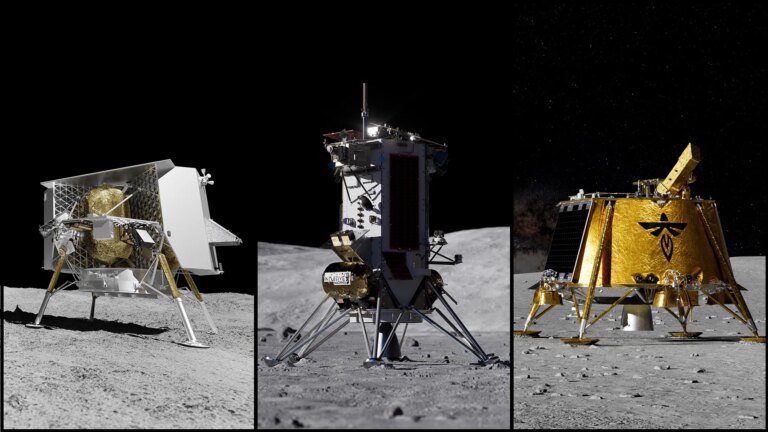
Astrobotic received awards for two flights of its Peregrine lander, with a total value of $297.9 million. Firefly received an award for its Blue Ghost lander worth $144.2 million. Intuitive Machines won an order for its Nova-C lander worth $148.3 million.
Each lander will carry an identical set of three payloads. Stereo Camera for Lunar Plume Surface Studies, or SCALPSS, uses cameras to study the plume of regolith created by the exhaust of the lander’s engines. Linear Energy Transfer Spectrometer, or LETS, measures the radiation environment in transit to the moon and on the surface. The Laser Retroreflector Array is a small passive instrument that reflects lasers used for lunar rangefinding. Versions of all three payloads have flown on previous lander missions.
“By flying the same science instruments on multiple landers, we will better understand potential hazards during landing and build out a global network of environmental data and location markers on the moon,” said Joel Kearns, deputy associate administrator for exploration in NASA’s Science Mission Directorate, in a statement, comparing the payloads to weather stations.
NASA did not disclose the landing sites for the missions. Astrobotic said in a statement about its awards that its two landers will go to the Gruithuisen Domes region on the near side of the moon. The agency added it will consider additional payloads for the landers.
The awards are the sixth lander mission for Intuitive Machines, which has made two partially successful landings, and the fifth for Firefly Aerospace, whose first mission was a success. The Astrobotic awards are the third and fourth for the company but the first since NASA selected it in 2020 for the Griffin-1 mission.
The awards come as Astrobotic completes Griffin-1, which is scheduled to launch late this year on a mission NASA recently redesignated Moon Base 2.
“The experience gained from our first two lander programs has matured both our team and our technologies, and we look forward to applying those lessons to Peregrine-2 and Peregrine-3 as we continue supporting NASA in building America’s Moon Base,” John Thornton, chief executive of Astrobotic, said in a statement.
“We have been ensuring that they have the production capacity for that,” Carlos García-Galán, NASA program executive for Moon Base, said of Astrobotic’s award in the presentation. “They do have the production capacity to complete Griffin-1 and go into the production of two landers — as a matter of fact, more than that — and they’re actively working on expanding even beyond that.”
Intuitive Machines said its $148.3 million award was split into two parts. The company would get $68.6 million in a base award for the mission but $79.7 million in a “performance incentive” for demonstrating the ability to provide “a steady, rapid-turnaround supply of landers.”
“We are shifting the paradigm from custom aerospace engineering to commercial mass production of lunar infrastructure,” Steve Altemus, chief executive of Intuitive Machines, said in a statement. “This contract directly advances our core mission to provide persistent, reliable and commercial baselines of transport, connectivity and operations that allow our customers to stay longer and achieve more on the moon.”
A rover PROMISE
NASA also announced as part of the Moon Base update that it is studying sending to the moon a rover originally developed for Mars missions. The rover, which the agency is calling the Polar Rover for Observation, Mapping, and In-Situ Exploration, or PROMISE, is an engineering model of the Curiosity and Perseverance rovers.
“We are thinking very hard right now about sending PROMISE to the moon,” NASA Administrator Jared Isaacman said during the presentation, calling it part of efforts he previously announced to “raid the pantry at every one of our centers” for payloads to fly on lander missions. The rover, he said, is at the Jet Propulsion Laboratory and is used to support operations of the Mars rovers.
NASA did not disclose what instruments PROMISE would carry, but García-Galán said one capability will be its ability to survive the lunar night and enter permanently shadowed regions. PROMISE, like the Mars rovers, would have a nuclear power source, a radioisotope thermoelectric generator, or RTG.
That contrasts with VIPER, a rover NASA has developed to go to the moon to look for lunar volatiles and is scheduled to launch in 2027 on Blue Origin’s Blue Moon Mark 1 lander. VIPER uses solar power. “With PROMISE we would not be constrained by solar power,” he said.
“The idea is that we have hardware now that was designed for an incredibly harsh environment,” Isaacman said. “That is an extremely capable vehicle, so there’s very little that would, I think, hold us back from making use of that hardware at this point.”
However, flying PROMISE could pose challenges for other NASA missions given the limited supply of RTG units. NASA officials have stated in recent meetings that plans for soliciting proposals for future New Frontiers planetary science missions will depend on the availability of RTGs needed for some potential destinations in the outer solar system, as well as for a Uranus orbiter flagship mission recommended by the planetary science decadal survey.
Other updates
The presentation about the new lander missions and repurposed rover came a month after NASA held its last briefing on the Moon Base program, where it selected four companies for projects related to that effort, including lunar rovers that astronauts will drive.
NASA also designated the three lander missions already in development as Moon Base 1, 2 and 3, including the first Blue Moon Mark 1 lander as Moon Base 1. However, two days after the event, Blue Origin’s New Glenn rocket, which will launch Blue Moon, exploded on its launch pad during a static-fire test.
After the explosion, NASA said it was considering alternative options for launching both the robotic Blue Moon Mark 1 lander and the larger, crewed Mark 2 lander. In this update, though, NASA said it is leaning toward keeping Blue Moon on New Glenn given the company’s progress in recovering from the explosion and rebuilding the New Glenn launch pad.
“Plan A is very much still to launch the Mark Ones on New Glenn, and we have time,” Isaacman said. “Plan A is looking a lot better today than it was weeks ago, just based on the progress that the Blue Origin team is making.”
Blue Origin reiterated in a June 30 statement that it plans to repair Launch Complex 36 and return to flight by the end of the year, but Isaacman said NASA was willing to wait a little longer.
“They are very committed to getting back in the business of launching New Glenn before the end of the year,” he said. “We’ve got time beyond that point into 2027 before we’re getting nervous.”
“It would not be an impact to the Moon Base development if we even went into 2027,” García-Galán added. He said the agency would be willing to wait until the middle of 2027 before considering alternative launch options for the Mark 1 lander. “But, as the administrator said, we’re sticking to Plan A for now.”