In 1776, the moon was a clock, a calendar and a streetlight — and it was 31 feet closer to Earth
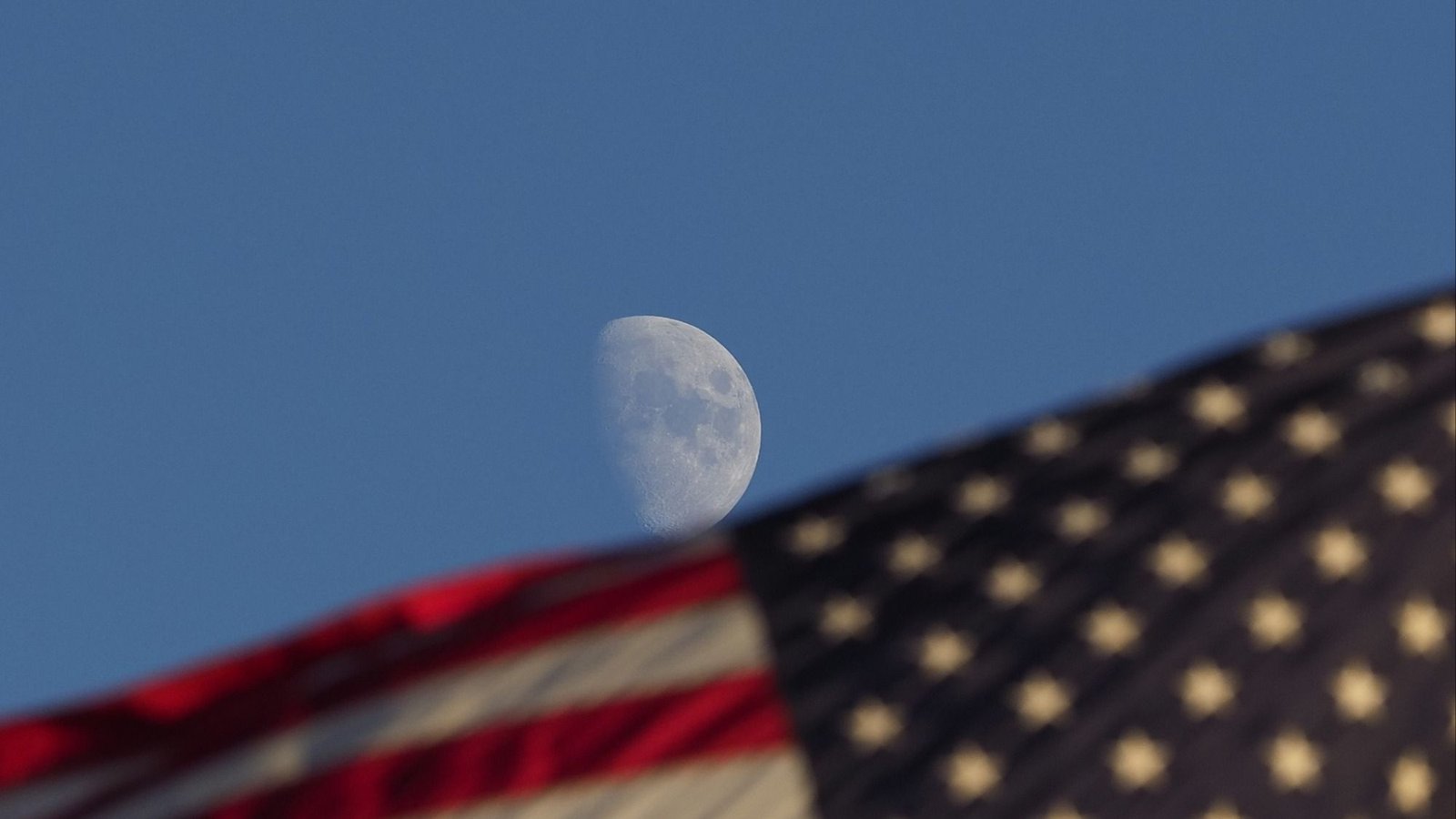
After Americans declared independence on July 4, 1776, a waning gibbous moon rose in the night sky. To the people celebrating the birth of a new nation, it would have looked much the same as the moon we see today. But there was one subtle difference: 250 years ago, the moon was about 31 feet (9.4 meters) closer to Earth than it is now.
“The moon is currently drifting away from Earth at a rate of about 3.8 centimeters [1.5 inches] per year, which is coincidentally roughly the same speed at which human fingernails grow,” says Seth McGowan, president of the Adirondack Sky Center & Observatory in Tupper Lake, New York.
How Americans used the moon in 1776
Colonial Americans depended on the moon in ways that are easy to forget in an age of electric light and digital clocks. Travelers planned journeys around how much moonlight would be available on a given night. Farmers and Indigenous peoples consulted lunar cycles to anticipate seasonal changes. Mariners tracked the moon’s pull on the tides. Even military planners considered lunar illumination — during the Revolutionary War, a moonlit night could aid troop movement and navigation, but it could also expose an army’s position to enemy forces. The moon helped people organize their activities in an era when daily life remained closely tied to the natural world.
One of the most popular publications of the colonial era was the almanac. Long before weather apps — or even standardized timekeeping — Americans turned to these annual guides for practical information about moon phases, moonrise and moonset times, eclipses, tides, and seasonal events. Publications such as Benjamin Franklin’s “Poor Richard’s Almanack” helped popularize the format decades before independence, while later titles, such as “The Old Farmer’s Almanac,” first published in 1792, continued the tradition.
What astronomers knew about the moon in 1776
By the time the Declaration of Independence was signed, astronomers already understood a surprising amount about Earth’s nearest neighbor. More than 160 years earlier, Galileo’s telescopic observations had revealed mountains, valleys, and craters on the lunar surface, overturning the ancient notion that heavenly bodies were perfect spheres. Isaac Newton’s laws of motion and gravitation had since explained why the moon orbited Earth and why tides occurred.
While astronomers could predict eclipses and chart the moon’s movements with impressive accuracy, they had never seen the moon’s far side, had no idea how it formed, and couldn’t say with confidence what it was made of. All of that would come centuries later — and there are still many lunar unknowns today.
How Apollo astronauts revealed the moon’s slow escape
“The moon’s gravity pulls on Earth’s oceans, creating a tidal bulge,” says McGowan. “Because Earth rotates faster than the moon orbits us, that ocean bulge pulls slightly ahead of the moon, acting like a cosmic gravitational leash that accelerates the moon into a higher, wider orbit. In doing so, the Earth’s rotation slows ever so slightly — about 2.3 milliseconds per century. “Back in 1776, a day on Earth was about 5.75 milliseconds shorter than it is now,” says McGowan.
This effect is imperceptible on human timescales, but over millions of years, it will have dramatic consequences. Eventually, the moon will appear too small in Earth’s sky to completely cover the sun, ending the era of total solar eclipses and leaving only annular, or “ring of fire,” eclipses in their place. The moon will never completely free itself from Earth, though — physics dictates that the drift will stop after about 15 billion years. And well before that, in about 5 billion years, the sun will expand into a red giant, consuming both the Earth and the moon entirely.