Divers Found More Than 400 Gold Coins on the Seafloor, but It Took Researchers 30 Years to Identify the Ship They Came From
A remarkable haul of more than 400 gold coins found off the coast of Devon, England, has finally been linked to the ship that carried it. After 30 years of archaeological work and historical research, investigators have identified the wreck as the Dom van Keulen, a Dutch merchant vessel transporting Moroccan gold during the 17th century.
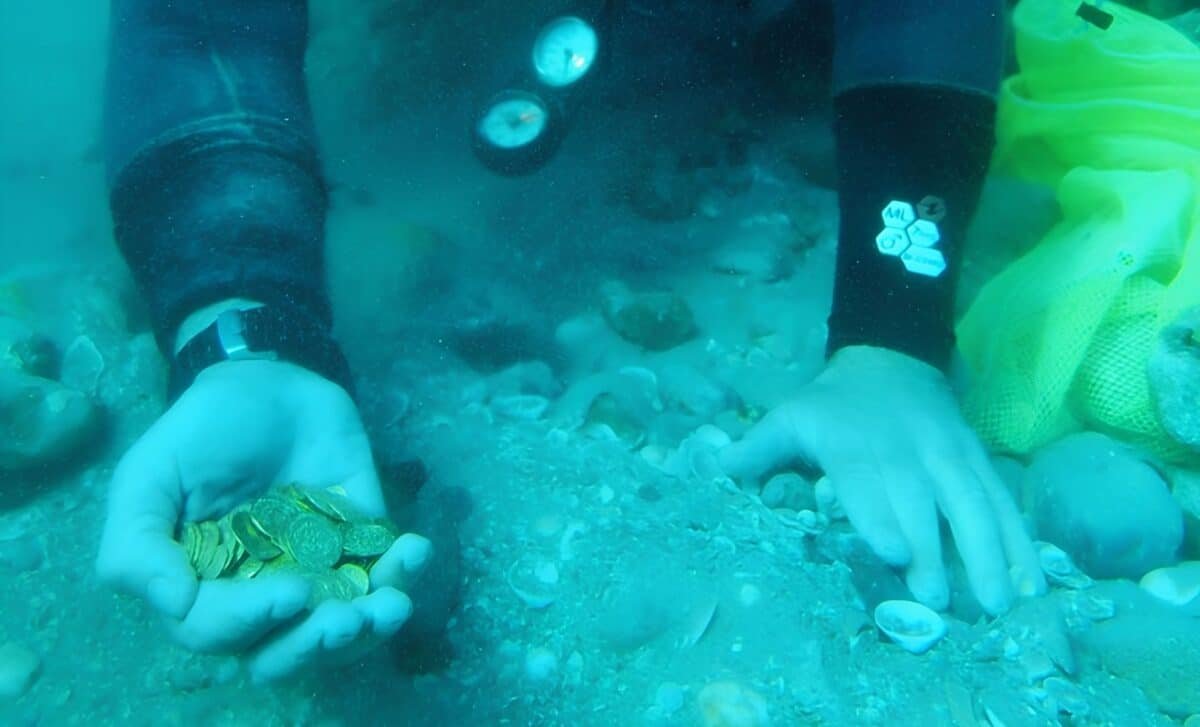
The discovery began in 1995, when divers uncovered an unexpected collection of coins and artifacts lying about 60 feet below the surface. Piecing together the ship’s identity took decades, with clues emerging from both the wreck itself and centuries-old archival records.
The coins, now on display at the British Museum, were minted on Morocco’s Barbary Coast using pure West African gold. Around them, divers recovered gold jewelry, a nugget of pure gold, a fish-shaped sounding weight, pottery, resin-coated pills, faba beans, cannons, anchors, and fragments of wood, rope, and lead from the vessel. The wreck stretched roughly 100 feet across the seabed, although none of those finds initially revealed which ship had been lost there.
An Ordinary Bowl Solved an Extraordinary Mystery
The breakthrough came from two objects that seemed far less remarkable than the gold itself. Analysis revealed that a pewter bowl and spoon recovered from the site were Dutch in origin, giving researchers their strongest lead yet. At the same time, maritime historian Ian Friel uncovered archival documents describing a merchant ship whose cargo closely matched the artifacts recovered from the wreck.
Dave Parham, professor of maritime archaeology at Bournemouth University and editor of the new book detailing the investigation, said that the Dom van Keulen was carrying a cargo that ultimately helped researchers confirm the ship’s identity after decades of uncertainty.
“Among its cargo were 150 bags of gum arabic, 64 bags of saltpetre, 320 goat skins, and 9,000 Barbary ducats, gold Moroccan coins,” he noted in a statement. “It is thought that most of the cargo was salvaged at the time, but more than 400 coins remained on the seabed until they were discovered by the South West Maritime Archaeology Group in 1995.”

The authors also wrote that there was considerable debate following the original discovery, although the growing body of archaeological evidence increasingly pointed to a Dutch vessel.
The Cargo Reveals a Vast Trade Network
Identifying the wreck also places the discovery within the broader trading system that linked Morocco with northern Europe during the 17th century. As reported by the British Museum, the new book explains that Dutch merchants exchanged manufactured goods produced in the Netherlands for West African gold acquired through Morocco. That gold was often melted down to produce Dutch coins, which became one of the leading trade currencies used across maritime routes.
The researchers describe the recovered coins as a bullion hoard that offers fresh insight into the numismatic history of the period. The wreck also produced 16th- and 17th-century Moroccan jewelry, which they describe as rare surviving examples from that era.

Parham said the discovery also provides valuable context for the wealth and architecture of the Sa’dian Sharifs while offering tangible evidence of the maritime trade linking Morocco, the Low Countries, and Britain.
A Discovery Decades In The Making
Although the ship has now been identified, much about the Dom van Keulen remains unknown. No painting of the vessel is known to exist, and researchers say its dimensions can only be estimated from the footprint left by the wreck site.

Jeremy Hill, Head of Research at the British Museum, said the discovery of African gold off the coast of Devon immediately raised questions about how it came to be there.
“The discovery of African gold from under the sea off the coast of Devon was an amazing discovery that raised so many questions about how it came to be there,” Hill said. “Answering those questions has taken a team of experts, working collaboratively. The story can now be told of how a Dutch ship carrying North African gold was wrecked off the English coast, making this a discovery of international importance. It reminds us how much there is still to be found under our seas.”